Digital Currency Payments for the Luxury Market
[Last updated: October 15, 2026]
The luxury industry's active customer base is shrinking fast. It fell from 400 million consumers in 2022 to around 330 million in 2025, according to Bain and Altagamma. Brands are having to compete harder for a smaller pool of high-value customers.
At the same time, more than 700 million people worldwide now hold digital currency, up from around 560 million in 2024. That’s roughly 8.5% of the global population. For many of these shoppers, stablecoins offer a faster, cheaper, and more reliable way to pay across borders than an international card.
This is why a growing number of luxury retailers and marketplaces, from global platforms to specialist boutiques, are adding stablecoin payments at checkout. In this article, we’ll explain why stablecoin payments matter for luxury retail, how they fit into the customer journey, and what to look for in a stablecoin payment provider.
Why stablecoin payments matter for luxury retail
International card payments are often declined for cross-border purchases, even when the card itself is perfectly valid. Issuers may flag cross-border transactions as higher-risk and decline them automatically. That's a real barrier for a global luxury marketplace: a legitimate customer could be rejected at checkout simply because the purchase crosses a border the issuing bank doesn't trust.
Stablecoin payments sidestep that problem. The customer pays from their own wallet instead of through a card network, so the transaction isn't subject to the same cross-border decline rules.
Stablecoin payments also tend to be cheaper. Cross-border card payments typically cost merchants around 4-6% of the transaction value once processing, international card fees, and currency conversion are included, though this is a general cross-border benchmark rather than a luxury-specific figure, and larger retailers with negotiated processing rates may see somewhat lower costs. Stablecoin payments can bring that down to under 1%, regardless of transaction size.
In addition, stablecoin payments remove a key source of fraud-related losses for international merchants selling high-value items: chargebacks.
The data backs this up. Farfetch, the largest global marketplace for luxury fashion, has found that customers paying with digital currency typically spent 25% more at checkout than other shoppers. Triple-A CEO, Eric Barbier, has pointed to luxury retail as one of the strongest use cases for stablecoins in emerging markets, where card acceptance and cross-border approval rates can be weaker.
How a digital currency payment gateway works at checkout
At a luxury checkout, a digital currency payment gateway automatically converts the shopper's stablecoin into the merchant's currency, so neither side has to execute the exchange manually. The customer chooses their preferred currency, usually a stablecoin such as USDC (USD Coin) or USDT (Tether), from their existing wallet or exchange account, and the gateway locks in an exchange rate that guarantees the local currency value remains fixed.
On the merchant’s side, the transaction is processed in their own currency. The gateway converts the payment and it settles in their bank account, so they never have to hold or manage digital currency directly. Settlement is typically completed the following business day.
The results: higher order values and stronger loyalty
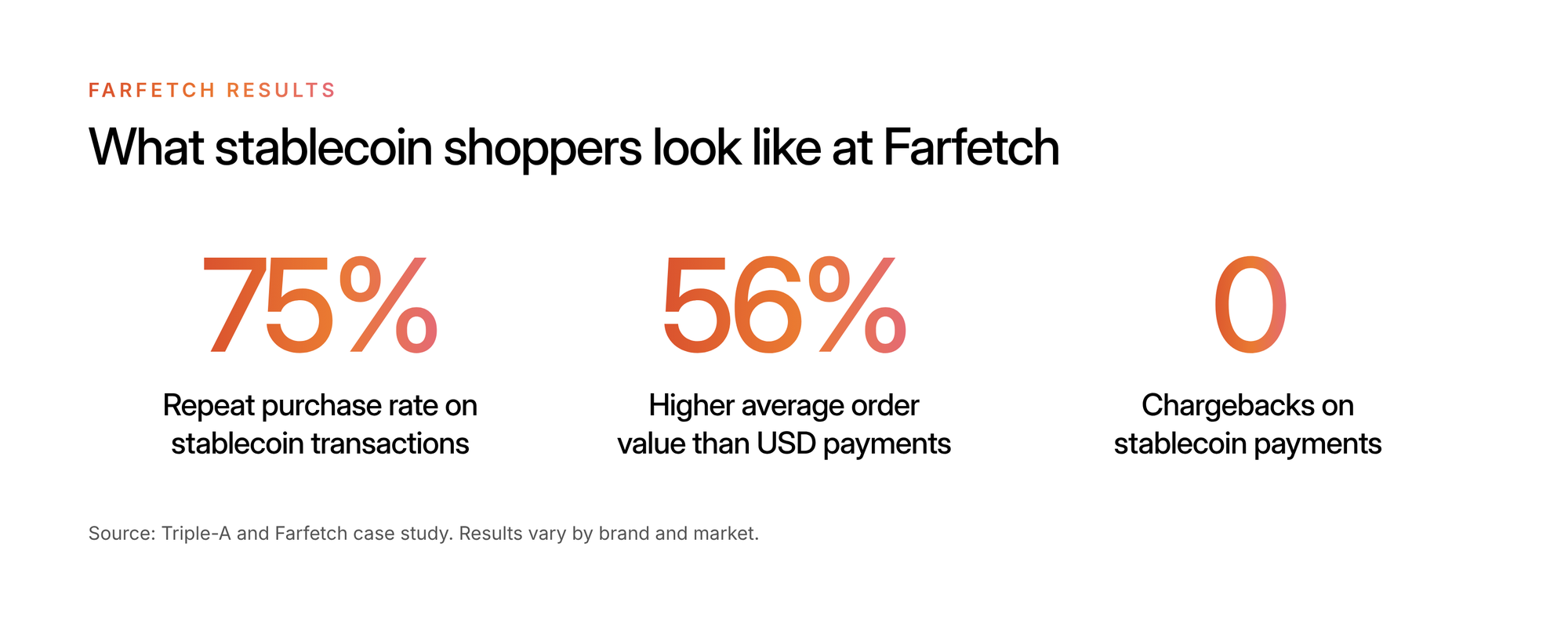
At Farfetch, the order value for stablecoin-paying customers is 56% higher on average than for those who use other payment methods. Three in four (75%) are repeat customers, and they make up 79% of the total digital currency payment volume. While results vary by brand and market, it's a strong signal of the kind of customer stablecoin payments tend to attract: shoppers who come back more often, spend more per order, and account for a disproportionate share of total revenue.
Which luxury brands are already using stablecoin payments?
Stablecoin payments are already in active use across the luxury retail sector.
Marketplaces
Farfetch, the fashion marketplace connecting shoppers in 190+ countries with 1,400+ brands and boutiques, built a white-label stablecoin checkout with Triple-A, with no redirects or third-party branding. In Singapore, handbag resale platform LuxLexicon added stablecoin payments at its Palais Renaissance store, allowing shoppers to avoid card fees and conversion costs.
Fashion retail
Charles & Keith was one of the earliest fashion retailers to add digital currency payments, launching Bitcoin, Ether, and Tether (USDT) at checkout through Triple-A in 2022. They implemented aQR-code system across Singapore, the US, Australia, Canada, Malaysia, the UK, and the EU, pioneering the kind of market-by-market rollout that brands are increasingly following.
Watches and specialist resale
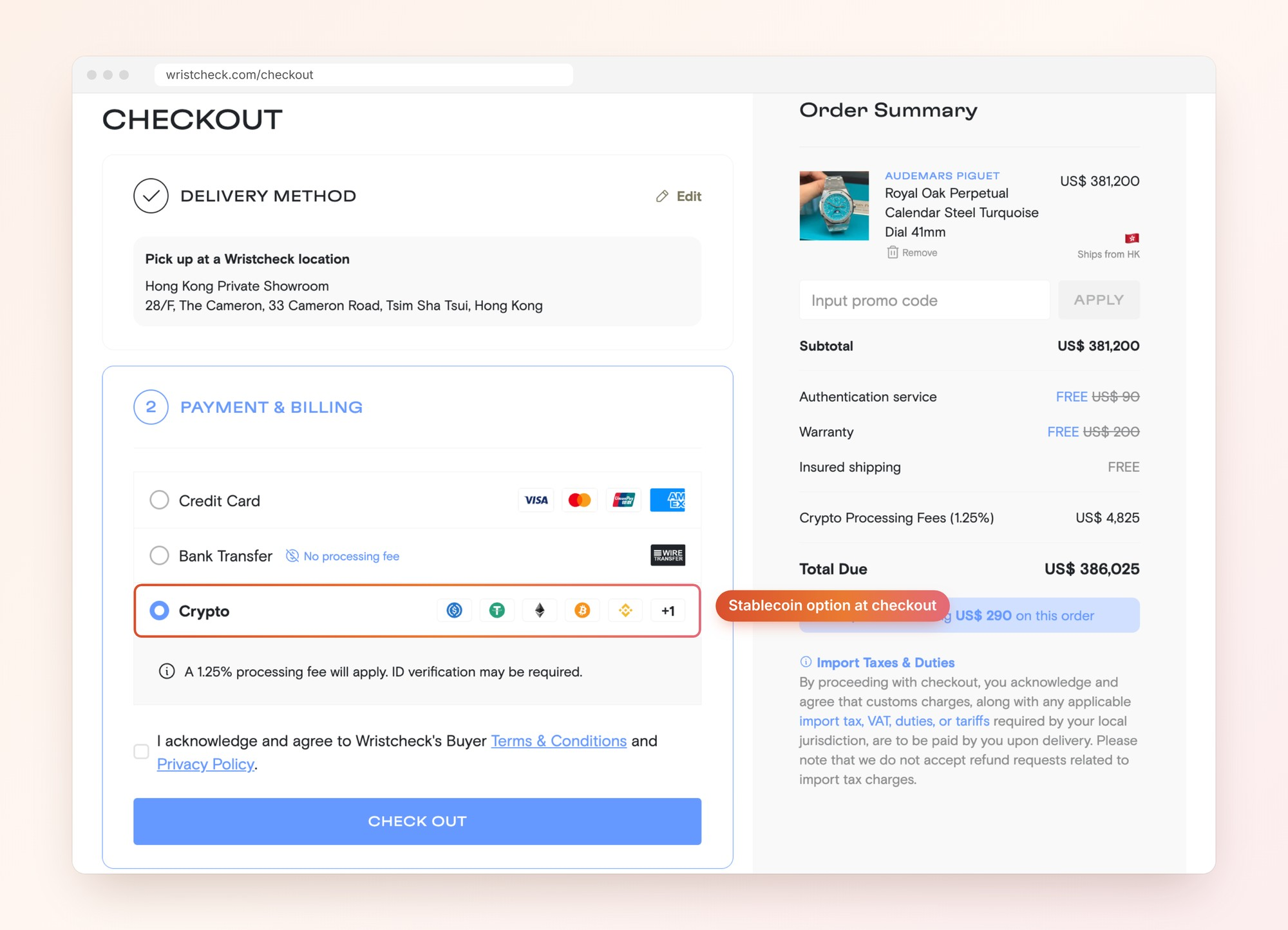
Hong Kong-based watch marketplace Wristcheck offers a stablecoin option at checkout, and similar payment choices are showing up elsewhere in the watch resale market, including Singapore's Watch Exchange and Swiss watchmaker Kerbedanz.
What to look for in a digital currency payment provider
A checkout that matches your brand: Look for white-label integration with no redirects or third-party branding, so the payment step feels as premium as the rest of the site.
Licensing across every market you sell in: Ask whether the provider holds payment and digital-asset licenses in each region you operate. Also verify if it offers built-in KYC, sanctions screening, and Travel Rule compliance, so that global business doesn't create unnecessary compliance work.
Settlement without holding digital currency: Check how the provider settles payments, whether it automatically converts to your own currency and settles to your bank account, or whether your business would hold digital currency directly, and pick the model that fits your risk appetite.
Infrastructure that scales with volume: Look for enterprise-grade APIs built to handle seasonal spikes and high-traffic moments such as sales or product drops, with real-time visibility into settlements and reconciliation.
Bringing digital currency payments to your marketplace
Stablecoin payments give luxury retailers a way to reach shoppers that traditional cards can't always serve, without adding checkout risk. From global marketplaces to specialist boutiques, brands that are already using digital currency payments often see higher order values, lower fraud exposure, and broader reach into markets that cross-border cards handle poorly.
A licensed provider makes the difference here. Triple-A is regulated as a Major Payment Institution in Singapore, a Payment Institution and Crypto-Asset Service Provider in the EU, and a registered Money Service Business in the US, so compliance travels with the payment rather than becoming the merchant's problem. Every transaction is screened against sanctions lists, the exchange rate is locked at checkout, and funds settle in the merchant's own currency the next business day, without the brand ever holding or managing a stablecoin directly. It's the same infrastructure already running checkout for Farfetch, LuxLexicon, and Wristcheck.
Ready to add stablecoins to your luxury marketplace or online store? Get in touch with our team.
*Triple A Technologies Pte. Ltd. is licensed as a Major Payment Institution (MPI) by the Monetary Authority of Singapore (MAS). Paytop SAS (Triple-A EU) is licensed as a Payment Institution by the ACPR and as a Crypto-Asset Service Provider (CASP) with the AMF in France. Triple A Technologies Inc. (Triple-A US) is registered with FinCEN as a Money Service Business and licensed as a money transmitter in various U.S. States.
FAQs
Are stablecoins the same as other cryptocurrencies?
Stablecoins are a type of cryptocurrency, but they work differently to cryptocurrencies such as Bitcoin or Ether. A stablecoin is pegged to a major currency, such as the US dollar, so its value doesn't fluctuate the way other cryptocurrencies do. That price stability is why most luxury marketplaces that accept digital currency, including Farfetch, offer stablecoins such as USDC or USDT as their primary option: it keeps the checkout price predictable for both the shopper and the merchant, without the swings a more volatile coin could introduce.
Does accepting digital currency expose a brand to price volatility?
Not necessarily. In the model most payment providers (including Triple-A) use, the gateway locks in the exchange rate at the moment of purchase. It settles the payment in the brand's own currency, typically the next business day, so the brand itself never needs to hold or manage the stablecoin. However, some providers and brands work differently and do hold digital currency directly, so it's worth checking how a specific provider's model works before assuming there's no exposure.
Why do international card payments get declined for luxury purchases?
Declined payments for luxury purchases often comes down to risk scoring rather than the customer's creditworthiness. Card issuers flag many cross-border and high-value transactions as higher fraud risks and decline them automatically, affecting legitimate shoppers buying from luxury marketplaces abroad. Stablecoin payments avoid this because they don't route through the same card networks or risk-scoring rules.
Can luxury stores accept stablecoin payments in person?
Yes. In-store stablecoin payment systems usually use a QR code that the customer scans with their digital wallet at the counter. The business receives the payment in local currency, the same way it does with online orders. LuxLexicon accepts stablecoins at its Palais Renaissance boutique in Singapore. Charles & Keith rolled out a QR-code checkout across seven markets.
Can a customer get a refund on a stablecoin payment?
Yes, the business can still issue a refund, even though the customer and their bank can't reverse the payment. That difference is what removes chargeback risk: the business decides on returns under its own policy, and no card issuer can claw the money back. How refunds are processed varies by provider, so ask your provider how they handle it.
Who handles compliance when a luxury brand accepts digital currency?
A licensed payment provider such as Triple-A handles most of the compliance work, including KYC checks, sanctions screening, and Travel Rule requirements. The brand doesn't need its own digital asset licence to accept stablecoin payments. You should confirm that the provider is licensed in every market where you sell.