Stablecoin Payments for Gaming Platforms: How to Reach More Paying Players
Stablecoin payments let gaming platforms accept in-game purchases in USDC or USDT from any player with a digital wallet, for less than 1% per transaction and with no chargebacks, while settling in USD, EUR, or other preferred local currencies.
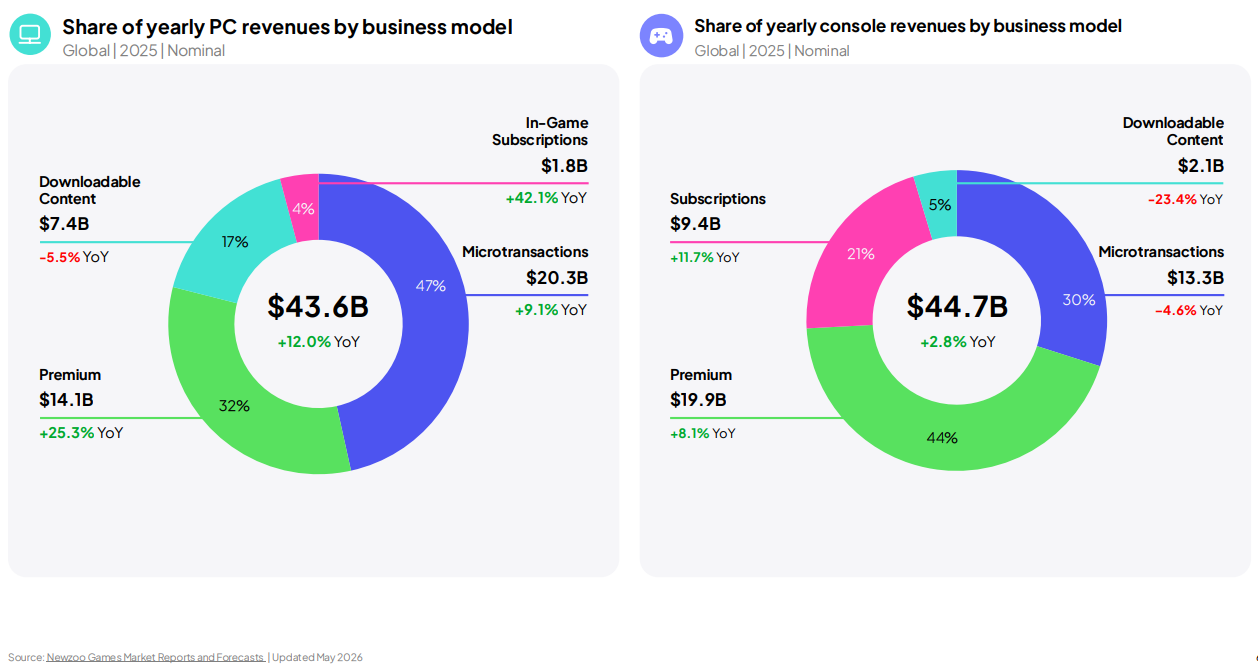
The demand for in-app purchases is already there. Players spend billions every year on skins, battle passes, and in-game currency. In 2025, mobile games alone generated $81.75 billion from in-app purchases, according to Sensor Tower. A Newzoo report via Game World Observer put microtransaction spend on PC and console at $20.3 billion and $13.3 billion, respectively.
Not all of those players have access to bank cards, though. Gaming is growing fastest in mobile-first markets like the Middle East and North Africa, where card use is low. However, more than 700 million people worldwide hold digital currency, and for gaming platforms, that’s an opportunity to reach players in those markets.
What’s more, digital currency owners tend to spend more: Triple-A data shows they spend 25% more per order than customers paying with traditional payment methods. That means stablecoin payments not only attract new paying players, but also players who spend more each time they buy.
In this guide, we look at why gaming platforms are adding stablecoin payments, how a stablecoin purchase works, how players can implement and optimize stablecoins in their game, and how one gaming marketplace grew its stablecoin transaction volume by 190%.
Gaming platforms are increasingly adding stablecoin payments as a method for gamers to make online purchases. For gaming businesses, stablecoin payments offer several advantages, including protection against chargebacks, 24/7 payment processing and faster access to funds. For gamers, they provide a convenient way to pay using digital assets.
Stablecoin payments allow platforms to reach players beyond the card networks
Many card companies classify gaming and digital goods as high-risk, which can limit the payment options available to gaming platforms. In addition, an increasing number of paying players are based in regions where cards aren’t widely used. According to PocketGamer, the Middle East and North Africa (MENA) are the fastest-growing regions for gaming, driven by mobile-first markets. Yet in the MENA region, only 26.2% of adults made a digital payment to a merchant in 2024, based on data from The World Bank.
Stablecoins don’t run on card networks, so any player with a digital wallet can pay. And because stablecoins are pegged to a traditional currency like the US dollar, they give players a predictable payment method, whatever their local currency. With Triple-A, gaming platforms can accept stablecoin payments from players in 140+ countries.
Stablecoin payments lower the cost of every purchase
International card payments add cross-border and currency conversion fees of 2–7% per transaction on average, once foreign exchange fees are included. On small, high-volume gaming purchases like skins and add-ons, those fees can add up quickly.
Because stablecoin payments don’t travel through the intermediaries that contribute to those fees, the average cost is less than 1% per transaction. Gaming platforms accepting stablecoins with Triple-A see up to 70% lower payment costs.
Stablecoin payments help protect revenue from chargebacks
In-game items are delivered instantly and are often used right away. If a player later disputes a card purchase, the gaming platform loses both the revenue and the item, and usually has to pay a chargeback fee.
Stablecoin payments are final once confirmed on the blockchain, so players can’t reverse them through a bank dispute. Refunds are handled directly by the platform under its own refund policy.
Stablecoin payments allow platforms to get paid 24/7
Gamers don’t stop on weekends or bank holidays like card settlement and bank transfers may. This means that payments made out of hours often won’t settle until banks reopen.
Stablecoins move on the blockchain 24/7, which means that gaming platforms receive the payment in their preferred currency the following day.
The table below shows a summary of how stablecoin payments compare with traditional card payments for gaming platforms:
How stablecoin payments work in gaming
If a gaming platform allows players to pay for in-game items in stablecoins, the player selects stablecoin at checkout, the payment is confirmed on the blockchain and the gaming platform receives the funds in its preferred currency. For players, it feels like any other checkout. For the platform, the stablecoin layer runs in the background, with no need to handle cryptocurrency at any point.
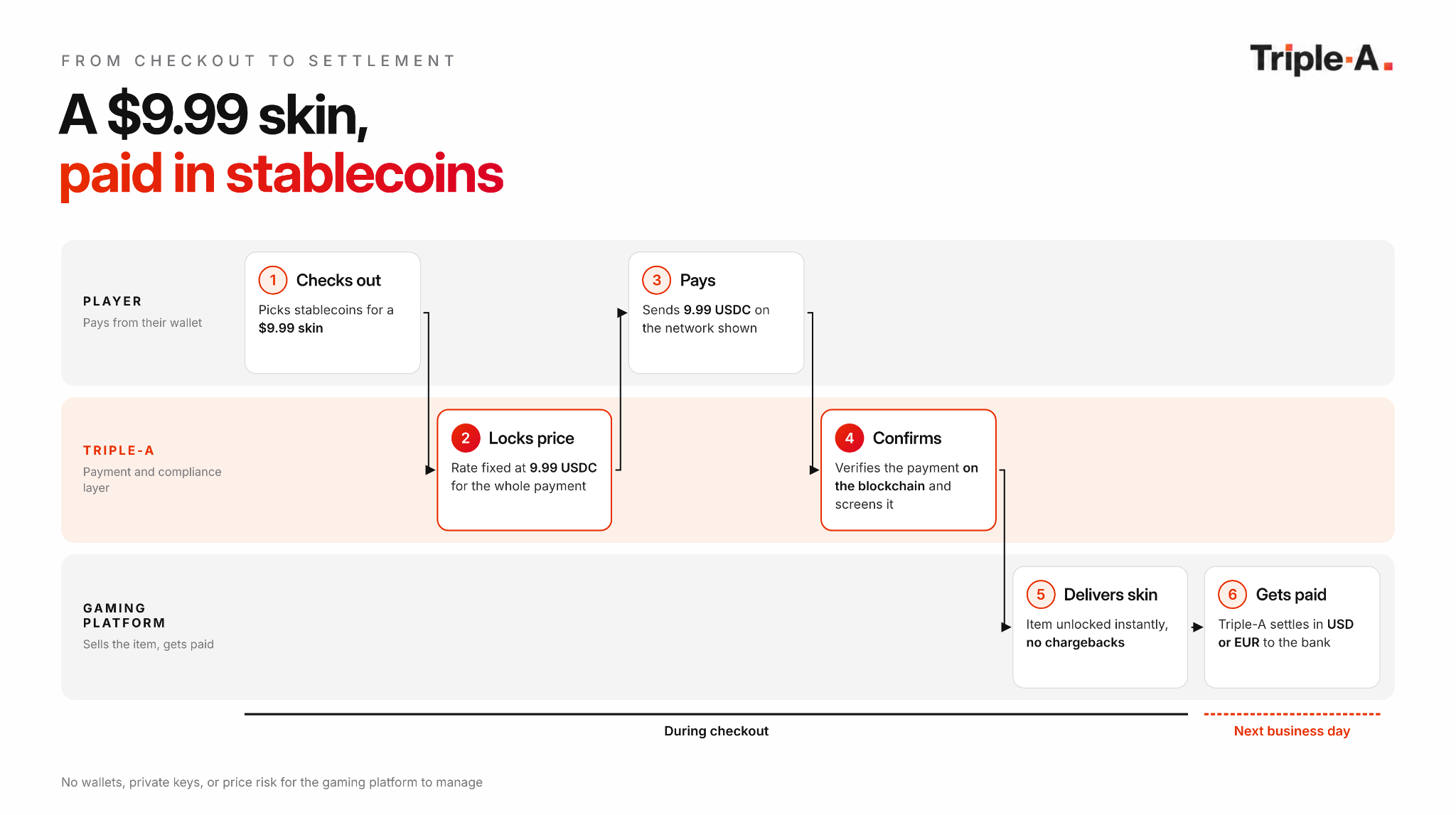
Let’s look at an example. Imagine a player who wants to buy a skin for $9.99:
On the player’s side
- At checkout, the player selects stablecoins. Having added the skin to their cart, the player selects stablecoins from the list of payment methods.
- They add the currency or wallet they want to use. The player can choose to use the stablecoin they hold, such as USDT or USDC, or they can connect to their existing exchange account.
- They complete the payment. The player sends the stablecoin equivalent of $9.99. This price is fixed when they confirm, and doesn’t change while the payment is in transit.
- They receive the item. Once the payment is confirmed, the skin is delivered to the player’s account.
On the gaming platform’s side:
- The platform receives the equivalent of $9.99. The fixed rate means the amount received isn’t affected by interim price movements.
- Funds settle in the platform’s preferred currency. On the next business day, the gaming platform receives the payment in the currency it uses. It can also opt to keep some or all of the balance in stablecoins.
- The platform uses its existing payment infrastructure. Because the stablecoin layer is handled by a provider such as Triple-A, the platform does not need to manage wallets, private keys, or the conversion between stablecoins and traditional currency.
Where stablecoin payments fit in your game
Stablecoin payments for gaming platforms fit anywhere you control checkout, whether that’s web stores, PC games, or gaming marketplace, regardless if players are on mobile or PC. External purchase links can be used where app stores, Steam, or console platforms run their own checkout systems.
Let’s look at these in more detail:
- Web stores. If you have a store that lets players buy items, currency, and bundles directly, you can add stablecoins alongside cards and other payment methods. Purchases are credited to the player’s in-game account.
- PC games and launchers. If you distribute through your own launcher, you can add stablecoins as a payment option without working around any store’s external linking or payments rules. Some PC stores also allow you to accept external payments, like stablecoin: according to Gamesbeat, developers on the Epic Games Store can use their own payment systems for in-game purchases, and Epic takes no revenue from those sales. Steam is the exception: in-game purchases by Steam customers must go through the Steam Wallet, so you can’t offer stablecoins as a payment option to players buying through Steam..
- Gaming marketplaces. Marketplaces like G2G and OffGamers run their own checkout and payouts, so stablecoin payment can be integrated on both sides of the transaction. At checkout, the marketplace adds stablecoins as a payment option next to cards and other methods, and the buyer pays from their crypto wallet. The marketplace holds the funds until the order is delivered, the same way it would with a card payment, then releases them to the seller. On the payout side, sellers can choose to withdraw their earnings in stablecoins instead of, or alongside, a bank transfer.
It’s important to note that consoles generally don’t allow third-party payments. Xbox, for example, requires all games on its consoles to use Microsoft Store or purchase APIs. That said, console players can still pay with stablecoins through a web store, where the game supports cross-platform purchases.
App store rules and stablecoins
On iOS and Google Play, in-app purchases of digital goods usually have to go through the stores’ own billing. Recent court rulings and regulations have opened exceptions in some markets:
- US: Following Epic v. Apple and Epic v. Google, developers can link players to an outside checkout from their apps. How much Apple and Google can charge on those purchases is still being decided.
- EU: Under the Digital Markets Act, developers can steer players to outside payment options, though reduced store fees still apply.
- Other markets: Japan has introduced similar rules, and more countries are likely to follow.
These rules vary by region and may change often, so it is advisable to check the current Apple and Google app store terms for each market before launching stablecoins.
How mobile players can pay with stablecoins today
Mobile players can pay with stablecoins in two ways:
- Through a web store, outside the app. Players find and visit the web store on their own, pay with stablecoins at checkout, and the purchase is credited to their game account. Because the app isn’t involved in the sale, app store billing rules and fees don’t apply to the stablecoin purchase. The trade-off is discovery: the game has to promote the store through channels such as email and social media. On iOS, web store items can be used in the app as long as they’re also available through in-app purchase.
- Through an external purchase link, from inside the app. In markets that allow it, such as the US, the EU and Japan, a button in the game sends players straight to a web checkout, where they pay with stablecoins and return to the game. This puts the stablecoin option in front of players at the moment they want to buy. Top studios like Moon Active, Scopely and Supercell already use external purchase links. The trade-off is that the app stores set the rules: each one has its own requirements for how these links look and what fees apply, so follow the current terms for every market where you add one.
Either way, the stablecoin payment happens on a web store, so link each player’s game account to it to make sure every purchase is credited in the game.
How to implement stablecoin payments in your game
To implement stablecoin payments in your game, choose a licensed payment provider, select your stablecoins and networks, integrate a checkout, and set your settlement preferences. There’s no need to rebuild your payment stack. Follow these steps:
- Choose a licensed payment provider. Look for a provider licensed in the markets you sell into. It should handle KYC/KYB checks, sanctions screening, and Travel Rule compliance for you, and settle to your bank account so your team doesn’t need to hold digital assets.
- Choose your stablecoins and networks. Start with USDC and USDT, which together make up more than 80% of all stablecoins in circulation. Support the networks your players already use, and favor low-fee networks for smaller purchases.
- Integrate your checkout. Triple-A’s API adds stablecoins as a payment option alongside cards and local payment methods across every purchase in your game. The white-label checkout sits inside your existing payment flow, with no third-party branding.
- Determine your settlement currency. Choose whether to receive funds in traditional currency, stablecoins, or a mix.
- Decide the frequency. Settlement can be next-day, same-day in certain currencies, or bulk weekly or monthly on request.
- (Optional) Turn on payouts. If you pay sellers, creators, or partners, the same infrastructure can send payouts in stablecoins. Payees can request payouts on your platform, and you can trigger them from the dashboard or automate them in bulk.
Tips to optimize stablecoin payments for your game
When implementing stablecoin payments for gaming platforms, there are four areas to focus on: conversion, trust, speed, and cost.
1. Conversion: Make stablecoins the easy choice
Players who hold stablecoins will only want to use them if the payment option is easy to find and quick to complete.
- Give stablecoins equal placement: List stablecoins alongside cards and wallets at checkout, not behind an “other payment methods” link.
- Promote stablecoins where cards fall short: Make the stablecoin payment option more prominent placement in markets where players may have limited access to cards, or where payments are often declined.
- Make wallet payments simple: Enable players to scan a QR code or open their wallet app directly from checkout, so they don't have to copy and paste payment addresses or navigate between different tools.
2. Trust: Instill a sense of safety and credibility
At the end of 2025, based on Crypto.com research, there were 741 million people worldwide who held cryptocurrency. That suggests many of your players already know how to pay with digital currency. However, paying in your game or paying with stablecoins specifically, may still be new to them. Having clear policies and processes and policies help them buy with confidence.
Here are some best practices:
- Use a licensed provider to handle compliance: This means that KYC/KYB, sanctions screening, and Travel Rule checks can be run behind the scenes without adding complexity for players.
- Make the network clear: Ensure players know which blockchain network they are using before they pay. Stablecoin payments are final, so a payment sent to the wrong address can’t be undone.
- Confirm payments in-game: Show a clear success message as soon as the payment is confirmed, as with a card purchase.
- Publish your refund policy: Stablecoin payments can’t be reversed through a bank, so inform players up front how refunds work.
3. Speed: Match the pace of your game
Games run 24/7, and players expect to receive what they buy as soon as they pay.
- Deliver items on confirmation: Unlock the skin, add-on, or currency the moment the payment confirms. Players shouldn't have to go through any manual review step.
- Pay sellers and creators around the clock: Stablecoin payments do not depend on banking hours, so ensure payouts are made promptly.
- Launch without disruption: Add stablecoins to your existing payment stack rather than replacing it, so players have an expanded range of payment options.
4. Cost: Keep more revenue from every purchase
Setting up stablecoin settlement and payouts strategically helps gaming platforms to be more cost effective and to maximize the savings of using stablecoins.
- Prioritize your most expensive markets: Promote stablecoins first in the markets where card fees, declines, and cross-border costs hit hardest.
- Avoid unnecessary conversions: If you pay sellers or creators in stablecoins, it's a good idea to reserve part of your balance in stablecoins for that purpose, instead of converting back and forth.
- Reduce dispute costs on high-risk purchases: Promote stablecoin payment on purchases where chargebacks happen most, such as high-value bundles or first purchases from new accounts. Once a stablecoin payment is confirmed on the blockchain, it’s final. A player can’t ask a card issuer to reverse it, so you don’t lose the sale or pay chargeback fees on it.
How G2G and OffGamers increased stablecoin transaction volume by 190%
G2G and OffGamers are global gaming marketplaces where players buy and sell in-game items, game credits, digital goods, and gaming services across 100+ countries. Their platforms operate 24/7— but their old payment systems didn’t.
Before adding stablecoins, sellers waited days for cross-border payouts to clear, lost a portion of every transfer to intermediary fees, and faced delays whenever banks were closed. At checkout, card restrictions on gaming and digital goods limited how players could pay.
“We deal with sellers in over 100 countries. Using legacy banking meant waiting days for transfers to clear, dealing with heavy intermediary fees, and most frustratingly, navigating banking hours.” — Ken Chee, Group CEO of G2G and OffGamers
G2G and OffGamers integrated Triple-A’s stablecoin infrastructure into their live platforms, in parallel with their existing payment methods. Buyers can now pay in stablecoins, and sellers can receive payouts in stablecoins, without the G2G and OffGamers team managing wallets or private keys, or handling digital asset regulations themselves. Triple-A’s licenses across the US, EU, and Southeast Asia gave G2G and OffGamers the compliance foundation to accept and send stablecoin payments across the world.
The results:
- 190% year-over-year increase in stablecoin transaction volume
- 5% year-over-year growth in the share of total transactions paid in stablecoins
- Payouts in seconds to minutes instead of waiting up to 3 business days in countries where access to traditional banking is limited
- Stronger seller trust and retention through faster, more reliable earnings
Start accepting stablecoin payments in your game
Stablecoin payments for gaming platforms offer a way to reach more players, lower payment costs, reduce our eliminate chargebacks, and get paid 24/7, all without replacing the payment methods your players already use.
Triple-A gives gaming platforms a single integration to accept stablecoin payments on in-game purchases and send payouts to sellers and creators. Players pay in the stablecoins they already hold, and platforms settle the payments in their preferred currency, without having to hold or manage any digital assets. Triple-A is licensed and registered across the US, EU, Singapore, and Canada, and screens every transaction against anti-money laundering standards, so compliance runs behind the scenes.
Many players already hold stablecoins. Gaming platforms that accept stablecoin payments reach more paying players and keep more revenue from every purchase.
To add stablecoin payments to your game, talk to the Triple-A team.