Global Mass Payout Solutions Compared [2026]
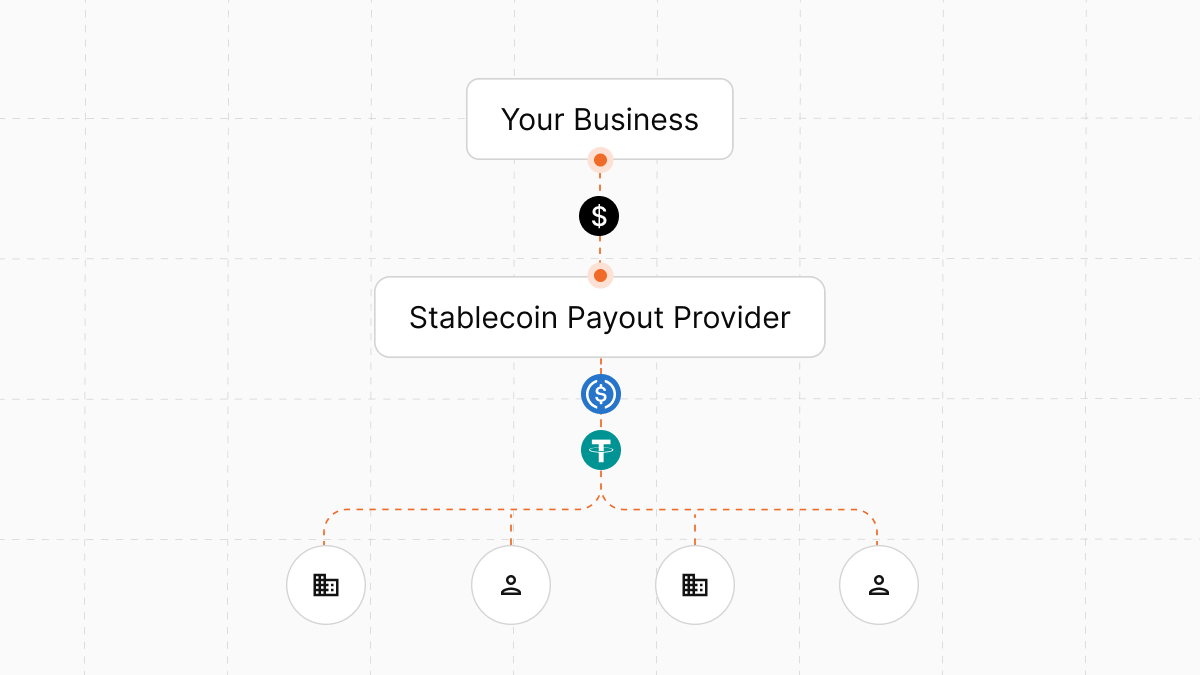
Paying one supplier is easy. Paying 5,000 sellers, freelancers, or creators across 40 countries every week is a different challenge entirely.
If you send those payments through the traditional banking system, you’ll quickly discover its limitations: fees of $25 to $50 per international wire, two-to-five-day settlement times, and zero visibility after the money leaves your account. Multiply that by thousands of recipients, and payouts can become one of your highest operational costs.
Mass payout solutions exist to remove these barriers. They enable businesses to send money to hundreds or thousands of recipients in a single batch. They handle compliance and currency conversion, and let both sides see where the money is at any given time.
In this guide, we’ll cover:
- What a mass payout solution is and who needs one
- Why traditional payouts break down at scale
- How the main payout methods compare
- The best mass payout solutions in 2026
- How to choose the right provider for your business
What Is a Mass Payout Solution?
A mass payout solution is a platform that lets a business send payments to many recipients at once, instead of processing each transfer manually. You upload a batch file or trigger payouts through an API, and the platform handles the routing, currency conversion, compliance checks, and delivery automatically.
In simple terms: one instruction in, thousands of payments out.
The key differences from regular payment gateways are direction and volume. Payment gateways collect money from customers. Mass payout platforms send money to recipients — often across dozens of countries and currencies.
Most mass payout platforms support several payout methods, such as bank transfers, digital wallets, prepaid cards, and increasingly, stablecoins.
Who Needs Mass Payouts?
If your business model involves paying a large number of individuals or small businesses on a recurring basis, you need a mass payout solution. The most common use cases include:
- Marketplaces and e-commerce platforms: These pay thousands of third-party sellers their share of each sale, often in different countries and currencies.
- Employer of Record platforms. Deel, Multiplier, Remotepass, Bitwage, and Remote manage contracts, onboarding, and compliance for global workforces, sending some of the highest volumes of cross-border payouts. They typically partner with payment providers such as Triple-A for the payment side, including stablecoin payouts.
- Gig economy platforms: Drivers, couriers, and freelancers expect fast, frequent payouts. The World Bank estimates that as many as 435 million people worldwide do online gig work, most of them in emerging markets.
- Creator platforms: Streaming, content, and affiliate platforms pay out earnings to creators globally, frequently in small amounts where per-transaction fees hurt most.
- Royalty platforms: Music, publishing, media, and licensing platforms distribute royalties to artists, writers, rights holders, and other beneficiaries, often across multiple countries and currencies.
- Gaming and esports: Prize money, in-game seller earnings, and tournament winnings need to reach players in markets where access to traditional banking is limited. Global marketplaces like G2G and OffGamers pay sellers across 100+ countries this way.
- Insurance, loyalty, and rewards programs: Claims, rebates, and incentives sent to large groups of recipients who may not be regular vendors.
- Remittance platforms: Money transfer providers need payout infrastructure to deliver funds to recipients across multiple markets, whether into bank accounts, digital wallets, or by stablecoins.
Why Traditional Payouts Break Down at Scale
Sending money abroad through the banking system means routing payments through a chain of intermediary banks, known as correspondent banks. Each of these adds time, cost, and the potential for something to go wrong. For a single payment, that may be manageable. At thousands of payments per week, it makes every payout cycle slower and more expensive than it needs to be.
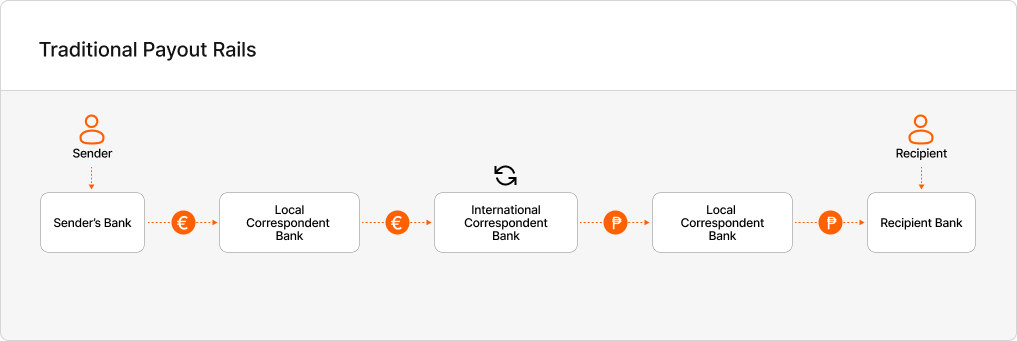
The costs stack up fast. According to IMF analysis of G20 cross-border payments data, average transaction costs vary significantly by payment type, from around 1.5% for retail B2B payments to more than 6% for remittances. Costs rise as payment sizes shrink, which makes small, frequent payouts the most expensive kind to send. On a $50 payout to a creator, that can mean up to $3 lost to fees and FX markups before they receive it.
Settlement speed is the second challenge. International wires typically settle in two to five business days, and they only move when banks are open. Depending on where your recipients are, they may have to wait through weekends and public holidays for money to clear.
Then there is the operational burden. Finance teams making payments through traditional wires often have to manage:
- Manual batch uploads across multiple banking portals
- Failed payments caused by incorrect account details, with slow and expensive returns
- Complex reconciliation across various currencies and banks
- Status inquiries from recipients, due to the lack of tracking visibility
At scale, payouts stop being a back-office task and become a serious growth impediment. If your payments are slow and unreliable, sellers, freelancers, and creators will look to competitors that can pay faster.
Payout Methods Compared
When it comes to paying people across borders, businesses have a range of options — from traditional bank transfers and international wires to digital wallets and prepaid cards.
Stablecoins — a digital currency pegged to a major currency such as USD — are an increasingly popular new option. In 2025, roughly $400 billion was settled via USDC and USDT for cross-border payments.
Each of these methods has its particular trade-offs in terms of speed, cost, and reach, as shown in the table below:
Most mass payout platforms offer a mix of these delivery methods, so users can choose the option that best fits their needs.
New to stablecoins? Start with Stablecoins 101.
Which Payout Platform is Best for Which Use Case?
There is no single platform that is perfect for every business. The right choice depends on where your recipients are located, how they want to be paid, and how much volume you push.
1. Triple-A
Best for adding global payouts in stablecoins and local currencies through a single licensed provider to an existing payment stack.
Payout methods: stablecoins (USDC, USDT, PYUSD) and 30+ local currencies across 70+ countries. Licensed in the US, the EU, and Singapore.
Triple-A is a licensed payment institution that lets businesses send stablecoin payouts and local currency payouts from a single platform, without holding or managing digital currencies themselves.
Triple-A is designed primarily as payment infrastructure rather than an all-in-one business finance platform. Businesses can integrate its APIs to send payouts in stablecoins or local currencies without building wallet infrastructure, managing digital assets or establishing individual payout connections across markets.
Payers fund payouts in a standard currency, such as USD or EUR; recipients choose their digital currency and network for stablecoin payouts, or their local currency for payouts to their bank account.
The stablecoin option is what sets Triple–A apart. It gives payers and recipients a reliable value for digital payments across markets. Payouts settle in minutes, run 24/7 including weekends, and typically cost under 1% — which really matters most in markets where bank transfers are slow, or recipients are underbanked. Triple-A also handles the digital-asset compliance layer, including wallet screening and transaction monitoring, so businesses do not need to build their own on-chain compliance processes. This is why marketplaces like G2G and OffGamers find Triple-A ideal for paying sellers in over 100 countries.
2. Tipalti
Best for end-to-end accounts payable automation for mid-market and enterprise.
Payout methods: ACH, wire, PayPal, prepaid card, and check, across 190+ countries.
Tipalti is less a payout tool and more a full AP department packaged as software. It covers supplier onboarding, tax form collection (W-9/W-8), invoice processing, approval workflows, and payment execution, then reconciles everything back to the company’s ERP.
That depth makes it a strong fit for finance teams paying large supplier and partner networks with heavy compliance requirements. That said, this makes it a bigger commitment: implementation takes time, pricing is built around a monthly platform fee, and payments run on traditional bank transfers rather than instant settlement.
3. Airwallex
Best for global businesses that combine multi-currency accounts, FX and bank payouts.
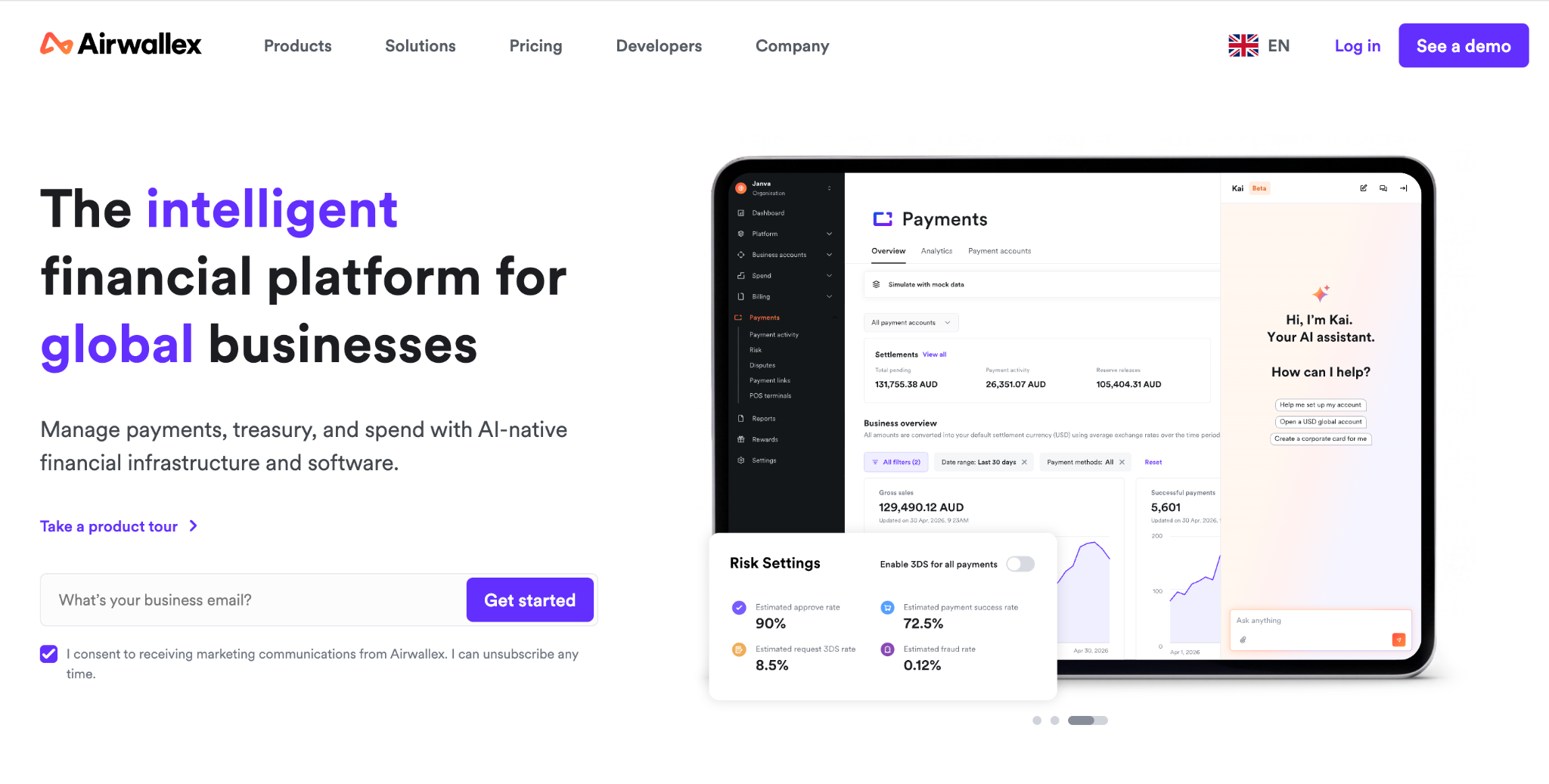
Payout methods: local bank transfers in 40+ currencies; batch payments of up to 1,000 transfers per file.
Airwallex is a broader financial platform that combines multi-currency business accounts, foreign exchange and global payouts. Its payout network connects to local clearing systems in more than 120 countries and regions, allowing businesses to route many international transfers through local banking rails instead of SWIFT. Businesses can make individual or batch payouts and automate transfers through APIs.
That makes Airwallex particularly well suited to companies that want to manage treasury, FX and payouts within the same financial platform. What sets it apart most from specialist payout infrastructure is its breadth: businesses that adopt Airwallex are typically in need of a more comprehensive financial stack, not simply a single payout rail to add to the infrastructure they already use.
4. Payoneer
Best for marketplaces paying freelancers and sellers who already use Payoneer.
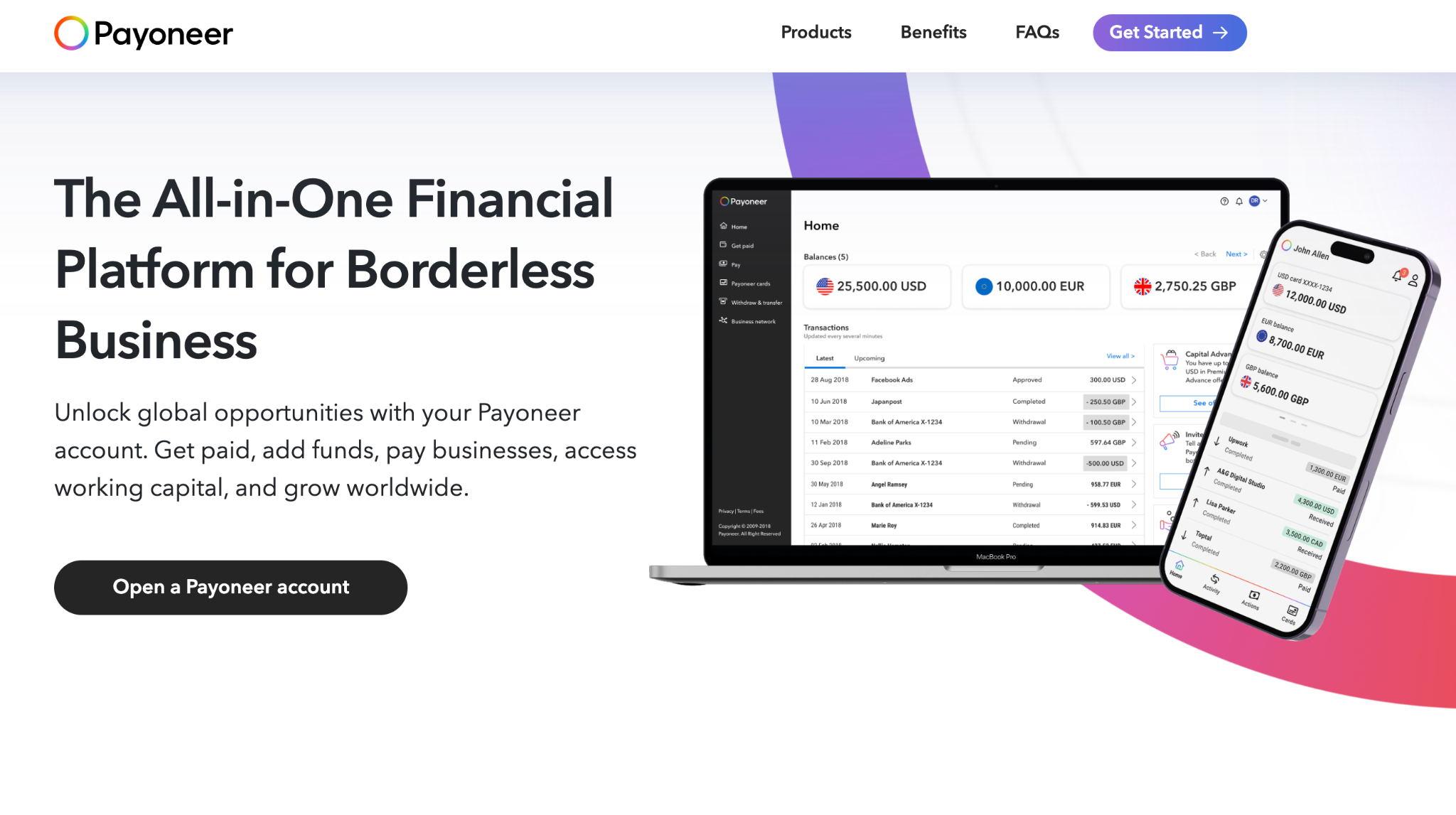
Payout methods: Payoneer accounts and local bank transfers in 190+ countries and 70+ currencies.
Payoneer's strength is its network. Millions of freelancers and sellers worldwide already hold Payoneer accounts, so payouts to those recipients land instantly and feel like a local payment. Recipients can hold balances in multiple currencies and withdraw locally.
The limitation is the flip side of the network: the experience is best when recipients are already operating within the Payoneer ecosystem. Withdrawal and currency conversion fees apply on the recipient side, typically up to ~2%, which effectively shifts cost onto sellers.
5. PayPal Enterprise Payouts
Best for consumer-scale payouts where recipients already have PayPal.
Payout methods: PayPal balances and Venmo (US), plus bank, wallet, and card via Hyperwallet in 200+ markets.
PayPal Payouts lets you pay thousands of recipients per batch via API. Its Hyperwallet subsidiary adds bank deposits, mobile wallets, and cards for recipients who want money outside PayPal. Brand recognition is a genuine advantage: recipients know and trust PayPal, so onboarding friction is low.
Costs are the main caveat. Cross-border fees and currency conversion spreads can add up quickly. It’s also important to note that recipients in markets without PayPal support cannot be paid this way at all.
6. Wise Business
Best for transparent FX on batch payments to bank accounts.
Payout methods: local bank transfers in 40+ currencies; batch payments of up to 1,000 transfers per file.
Wise built its reputation on mid-market exchange rates with a visible, upfront fee, and its batch payments tool brings that benefit to payouts. For businesses paying contractors and suppliers into bank accounts across major corridors, it is one of the cheapest and most transparent options.
It is a lighter tool than the previous platforms on the list: fewer payout methods, no supplier onboarding or tax workflows, and settlement still depends on local banking rails and hours.
7. Aspire
Best for businesses that combine finance operations with international payouts.
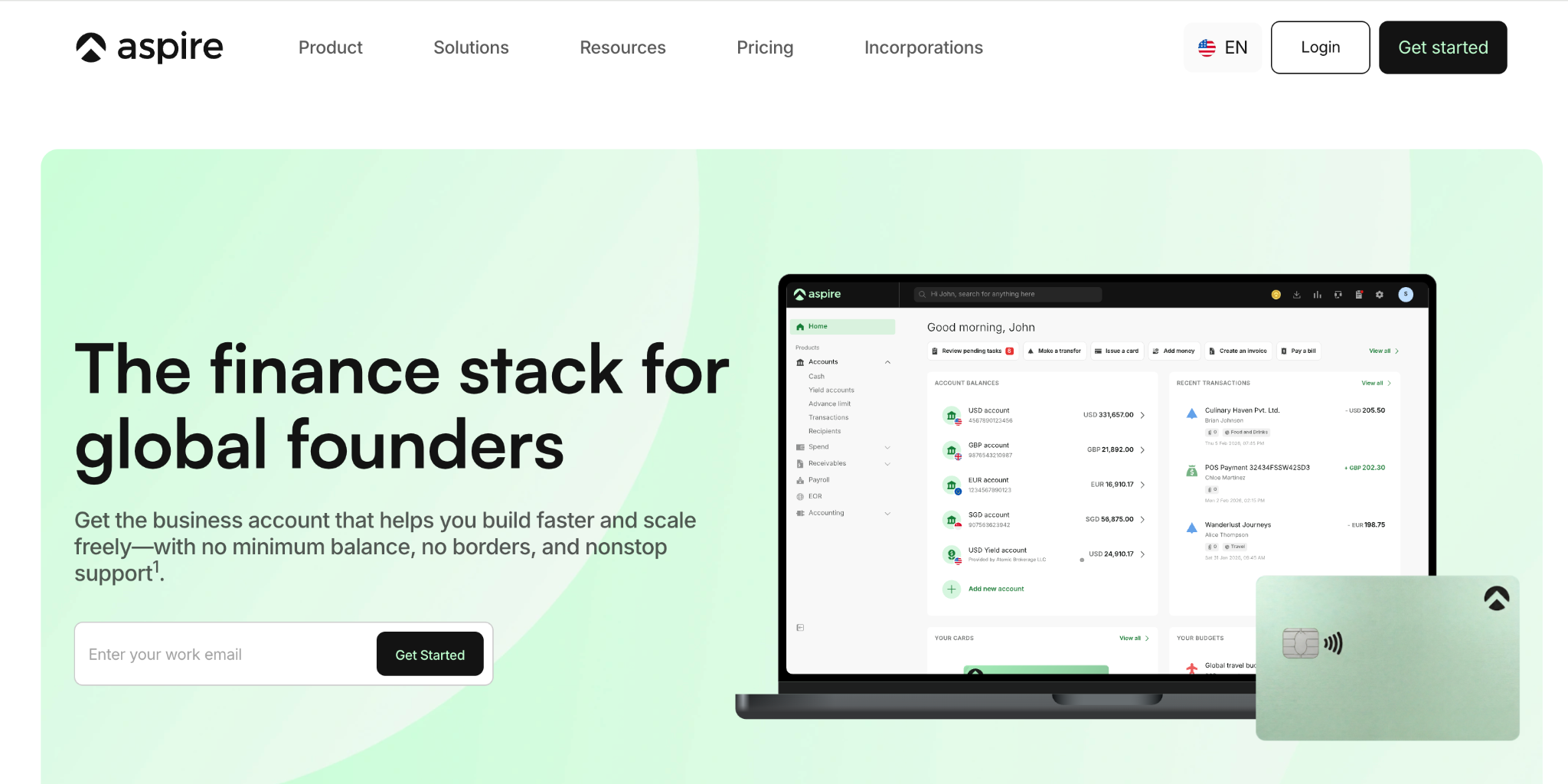
Payout methods: local and international bank transfers, including batch payments and SWIFT transfers.
Aspire is a business finance platform that combines multi-currency accounts, spend management, accounts payable, and international payments. Originally built for Asian-based businesses, it has expanded its reach and now supports accounts for companies across 16 markets. International transfers can be sent to most countries worldwide.
As with Airwallex, Aspire is a general financial solution rather than a specialist payout platform. In addition to payments, Aspire handles a range of finance operations, including bills, approvals, multi-currency balances, and batch transfers. This makes it a good fit for companies looking for a single-platform solution to consolidate finance workflows and international payments. However, product availability varies depending on the company's country of incorporation.
When Stablecoins Are the Right Payout Method
Stablecoins will not replace every payout method, and they should not. Bank transfers still carry most payout volume today, and if your recipients sit in well-banked markets such as the US or the eurozone, local rails such as ACH and SEPA are cheap and reliable.
Instead, stablecoin payouts complement traditional banking. Stablecoin adoption is strongest in emerging markets, where people often have less access to banking services. Recipients often have limited access to US dollars, so USDC or USDT offer them a reliable alternative.
Stablecoins really come into their own in some increasingly common situations:
- Cross-border payouts to emerging markets: Where correspondent banking is slow and expensive, a stablecoin transfer settles in minutes for typically under 1%.
- Recipients who want to hold dollars: In high-inflation markets, sellers and creators often prefer a dollar-pegged balance over local currency. Stablecoin supply has grown past $300 billion for a reason.
- 24/7 payout schedules: Blockchains do not close on weekends. Gig platforms and gaming marketplaces can pay out the moment earnings are ready.
- Underbanked recipients: In much of the world, a smartphone wallet is easier to access than a bank account.
When you opt for stablecoin payouts, it’s important to choose a licensed provider. Regulation has caught up quickly, with the GENIUS Act in the US and MiCA in the EU setting clear rules for issuers and providers. Your provider should handle KYC, sanctions screening, and travel rule requirements as standard. This will help ensure your mass payouts remain compliant and low-risk.
For a breakdown of the regulatory landscape, see Stablecoin Regulations: What Every Business Needs to Know in 2026. If you are choosing which coins to support, compare the top stablecoins for business payments.
How to Choose a Mass Payout Provider
Shortlisting your options comes down to matching the provider to your recipient base's needs. Work through these questions:
- Where are your recipients, and how do they want to be paid? Map your top 10 payout countries and check coverage, methods, and local currency support for each.
- Is the provider licensed? Look for regulatory licenses in the markets you operate in (MAS, EU payment institution or CASP status, US money transmitter licenses). Unlicensed intermediaries are a compliance risk you inherit.
- What does a payout actually cost? Add the per-transaction fee, the FX spread, and any fees your recipients pay to access the money. The advertised fee rarely tells the full story.
- How fast do funds arrive? Ask providers for settlement times by corridor, not global averages, and whether payouts run on weekends.
- Does the platform integrate with your stack? Check for API quality, batch upload options, webhooks for payment status, and reconciliation exports.
- What happens if a payment fails? Failed payout handling, retries, and recipient support will consume more of your team's time than successful payments ever do.
The best setups are often hybrid. Many platforms use local rails for well-banked corridors and stablecoins for the markets where banks are slow, expensive, or absent.
Pay Thousands of People in Minutes, Not Days
Mass payouts used to mean choosing between speed, cost, and reach. In 2026, businesses that combine local rails with stablecoin settlement no longer have to choose: sellers in Berlin get a SEPA transfer, sellers in Buenos Aires get dollars in minutes, and your finance team manages it all through a single integration.
Triple-A is a licensed payment institution that helps businesses send payouts in stablecoins and 30+ local currencies across 70+ countries. You pay in your local currency, your recipients get paid the way they prefer, and your business never holds digital currencies. For mass payouts, that means thousands of payments sent in a single batch, by file upload or through the API, instead of thousands of individual transfers.
Ready to see how Triple-A can help you pay more people faster? Get in touch with our team to talk through your payout volumes and corridors.
FAQs
What is the difference between mass payouts and payroll?
Payroll pays employees, with tax withholding, benefits, and employment compliance built in. Mass payouts pay non-employees such as sellers, freelancers, and creators, with the platform handling delivery and reporting while recipients manage their own taxes. Most businesses need both, often from different providers.
How much do mass payout solutions cost?
Expect a per-transaction fee, an FX margin on currency conversion, and sometimes a monthly platform fee. Traditional cross-border payouts often cost 3–7% all-in once FX is included, while local rails and stablecoin payouts can bring that to under 1%. Always model costs on your real corridor mix.
Are stablecoin payouts legal?
Yes, in most major markets, provided they run through licensed providers. The GENIUS Act in the US created a clear framework for payment stablecoins and their issuers, and MiCA in the EU covers both stablecoins and the companies that provide digital currency services. Businesses should verify their provider holds the relevant licenses in each operating market, such as money transmitter licenses in the US or payment institution status in the EU and Singapore.
Do recipients need to understand stablecoins to receive payouts?
No. With a provider like Triple-A, recipients can receive local currency in their bank account while stablecoins do the work in the middle, or they can receive stablecoins directly in a wallet if they prefer. The sending business pays in its own currency either way and never holds digital currencies.
What is the fastest way to send mass payouts internationally?
Stablecoin payouts are currently the fastest option for cross-border transfers, settling in minutes at any time, including weekends. Local rails such as SEPA Instant or domestic real-time payments are comparably fast but only work within their own region.