Blockchain Payments: The Complete Guide for Businesses (2026)
Many people think of blockchain payments as simply a niche way to move Bitcoin between wallets. But that’s no longer the case.
Blockchain payments are now commonly used by global businesses, with companies using blockchain to pay suppliers, collect from customers, and move money across borders. According to Boston Consulting Group’s January 2026 analysis, B2B stablecoin payments alone reached $150–230 billion in 2025, growing at roughly 65% a year. This is even faster than the growth of stablecoin payments overall, which grew 60% over the last year.
Many businesses are keen to diversify their payment options. But when it comes to blockchain, they may still have a lot of questions. What exactly are blockchain payments? What’s the difference between a blockchain payment and a blockchain payment gateway? Is blockchain payment processing the same thing as accepting crypto?
This guide breaks down the mystery around blockchain, explains how blockchain payments are processed, how to choose the right gateway, and ultimately what it actually means for your business’s bottom line.
What are Blockchain Payments?
A blockchain is a shared digital ledger: a record of transactions maintained simultaneously across a network of computers rather than a single institution. A blockchain payment, then, is a transaction when crypto assets are transferred through that ledger instead of through a bank’s internal system. When a business sends a blockchain payment, the transaction is verified by the computer network and the record becomes part of a permanent, tamper-resistant chain that every participant on the network can see.
In practice, this allows payments to settle faster than wire transfers, operate continuously even outside of banking hours, and move across borders without the time and cost of traditional international transfers. A payment that would otherwise take three to five business days to clear, while losing a percentage of its value to fees, can instead settle in minutes for a fraction of the cost.
Today, most blockchain payments use stablecoins, an increasingly regulated cryptocurrency pegged to the US dollar. This makes stablecoins ideal for payments, since their value remains steadier than the likes of Bitcoin, which can be volatile and change significantly in value mid-transfer.
Learn more about Stablecoin vs Bitcoin.
Blockchain Payments: A Glossary
This concept can seem complex, so here’s an overview of some of the key terms used when discussing how blockchain payments work:
- Distributed ledger: A database replicated across many computers that no single party controls or can change on their own.
- Blockchain: A specific type of distributed ledger that maintains a running record of transactions, grouped into batches called blocks. Each new block refers back to the previous one. This means that altering a past transaction would require redoing every subsequent block, and convincing the network to accept the doctored version. This makes it virtually impossible to successfully tamper with the blockchain record.
- Nodes: These are the computers that make up the network, store copies of the ledger, and verify new transactions against it.
- Public key: Every wallet is secured by a pair of cryptographic keys. The public key is effectively used as the account’s address and is safe to share.
- Private key: The second key authorizes any spending from the account, and should never be shared. Losing a private key means losing access to the funds it controls.
- Non-custodial wallet: In this scenario, the business retains full control of its own private keys and takes full responsibility for keeping them safe.
- Custodial wallet: A regulated provider holds the private keys for the business. This means the business trades a small amount of control for institutional-grade security and the ability to recover access if something goes wrong. Most enterprise blockchain payment wallets are custodial because the risk of an employee losing a private key is rarely worth the marginal control gained by self-custody.
How Blockchain Payment Processing Works
Blockchain payment processing involves a series of steps for moving stablecoins across the blockchain. While card processing routes a transaction through multiple intermediaries, blockchain payment processing depends only on the computers on the network checking and approving the payment.
The Payment Journey
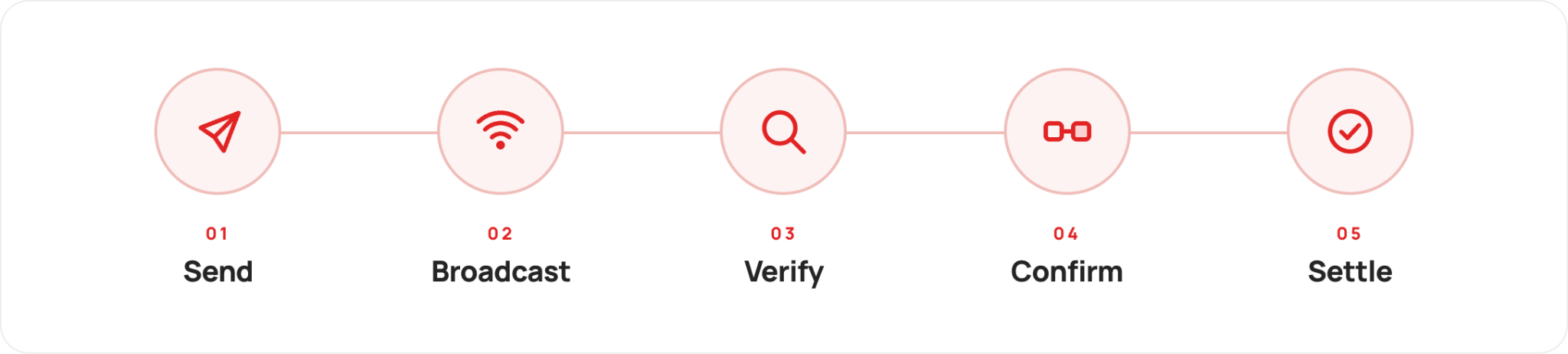
- Initiation. The payer opens their digital wallet, enters the recipient’s wallet address and the amount, and sends the payment.
- Broadcast. The transaction is sent out to the network and sits in a queue to be verified. This typically takes only a matter of seconds when using stablecoins.
- Verification. Network participants confirm the transaction is legitimate and that the sender has the funds they want to send.
- Block confirmation. Once verified, the transaction is bundled into a block and added to the chain, where it becomes part of the network’s permanent, publicly verifiable record.
- Settlement. The funds appear in the recipient’s wallet, typically within seconds or minutes, depending on the network.
If your business accepts blockchain payments directly into a crypto wallet, the transaction can end there.
Most businesses, however, will want to then convert the received stablecoins into the currency they use. A payment provider built for blockchain payments can complete this transaction for them.
Blockchain Payment Gateways: What They Are and How to Choose One
What Is a Blockchain Payment Gateway?
A blockchain payment gateway is the software or tool that makes sending and receiving transactions through a blockchain possible. It can be a checkout widget, API, or payment link that lets a business accept blockchain payments from customers or send them to suppliers and partners. It will usually also convert between crypto and fiat currencies.
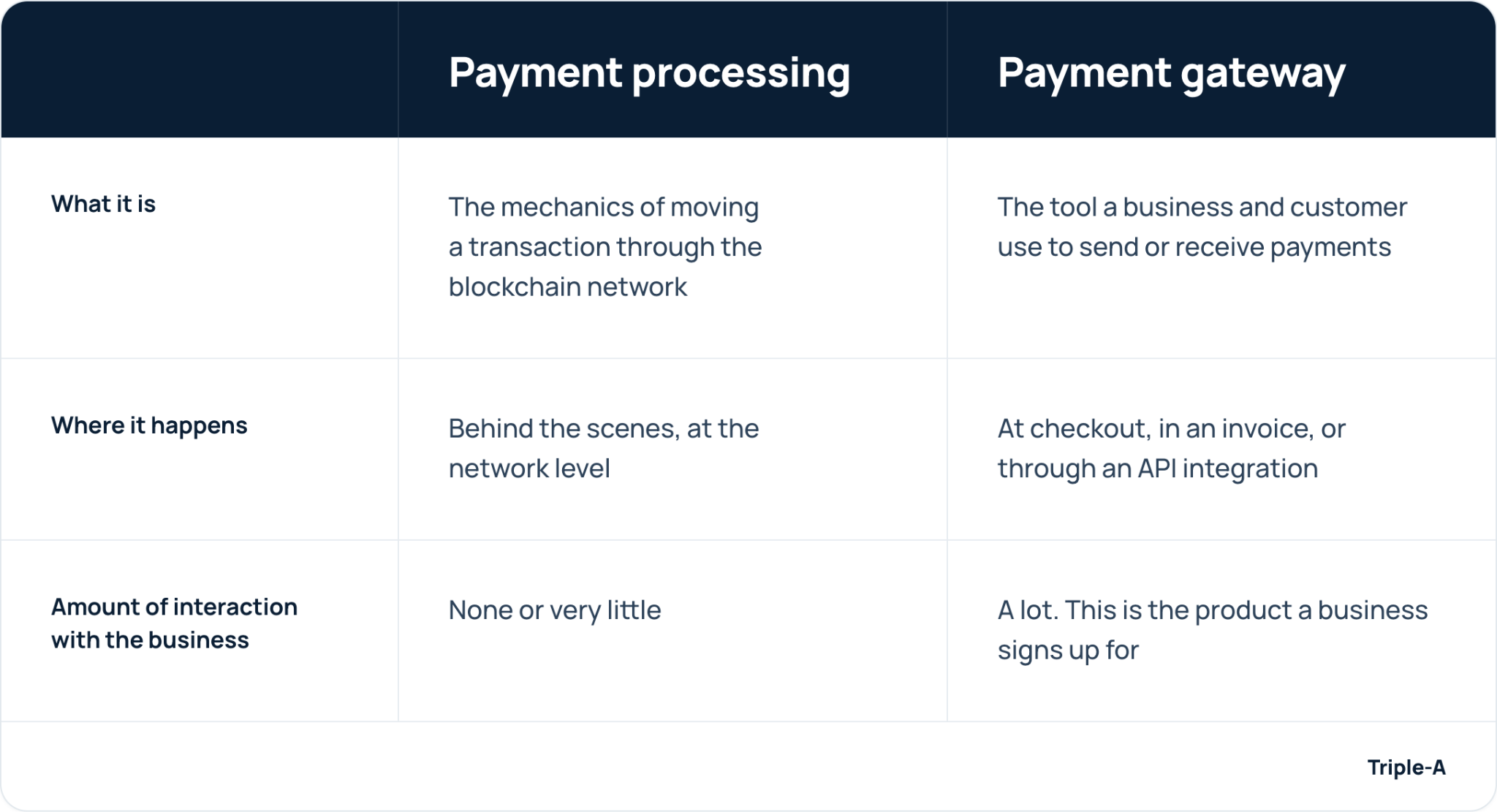
While payment processing is the behind-the-scenes mechanics, a payment gateway is the part of the transaction that a business and its customers interact with. A business doesn’t need to build the blockchain infrastructure from scratch in order to accept blockchain payments; it simply needs a gateway that can handle the payment processing for them.
A blockchain payment gateway allows a customer to select “Pay with crypto” or “Pay with stablecoin” at the checkout. The gateway will then generate a payment request with a locked exchange rate. The customer sends the payment from their own wallet, and the gateway confirms settlement and notifies the merchant. This process is often completed in less time than a card authorization.
What to Look for in a Blockchain Payment Gateway
Not all blockchain payment gateways are built for the same use case, and the right choice depends on what a business actually needs. Here are the key things to look into before choosing one:
- Licensing and regulatory coverage
A gateway operating without proper licensing can introduce compliance risk, with negative impacts for the businesses using it. Verify that your gateway has money transmitter licenses, e-money or payment institution licenses, and registration with the relevant financial authorities wherever your business operates.
- Settlement speed and currency
Check if the gateway settles in stablecoins or directly to fiat in a business bank account, and how quickly payments settle. Settlement timing can range from instant to next-day.
- Supported currencies and stablecoins
Make sure the gateway supports the specific stablecoins (USDC, USDT, and others) and blockchain networks relevant to your customer base and location.
- Security and custody model
Clarify who holds the private keys during a transaction, and whether the gateway offers custodial or non-custodial options.
- Integration effort
Some gateways offer a hosted checkout page that can be integrated in minutes, while others provide full API access for a custom-built payment flow that takes engineering resources to implement. Determine the right fit for your business’s needs, technical capacity and timeline.
- Fees
While blockchain payment gateways typically charge lower fees than card processors, the structure can vary. Request and review the full fee breakdown, not just the headline rate.
- Noteworthy clients and track record
Look at the provider’s client list, and take note of clients in your own industry. A gateway with established enterprise customers demonstrates that the provider has likely handled the relevant compliance and integration issues.
For a detailed look at how the leading blockchain and crypto payment gateways stack up, see our full breakdown of the best crypto payment gateways.
Benefits of Blockchain Payments for Businesses
There are many reasons that businesses are increasingly using blockchain payments across industries. Here are some of the key benefits:
- Speed
Blockchain payments settle in seconds or minutes, compared to 1–5business days for cross-border wires. This significantly impacts cash flow and supplier relationships.
- 24/7 availability
Blockchain networks aren’t limited to banking hours, weekends, or holidays. A payment initiated on a Saturday doesn’t have to wait until Monday morning to clear.
- Lower fees on cross-border transactions
Blockchain payments don’t rely on multiple correspondent banks that each take a cut. This typically makes it much cheaper than international bank wires, especially for locations with high banking fees.
- No chargeback risk
All payments made through the blockchain are final, eliminating chargeback fraud and the time and resources needed to dispute or resolve it.
- Access to underserved markets
Blockchain payments offer a reliable option for regions with limited banking infrastructure or currency instability. This opens the business up to customer and supplier relationships that otherwise would have been difficult to service.
- Transparency and auditability
Every transaction is recorded on a public, tamper-evident ledger. This helps to simplify reconciliation and provide a clear audit trail.
- Predictable costs at scale
Blockchain payments fees are typically flat or network-based rather than a percentage of transaction value. This makes them proportionally cheaper as transaction size grows.
Businesses can use blockchain payments alongside cards and bank transfers as an additional option for customers and suppliers. This parallel structure is one of the reasons adoption has been able to grow steadily without disrupting existing payment relationships.
How Triple-A Supports Blockchain Payments for Enterprises
For established businesses looking to add blockchain payments, Triple-A's digital currency payments platform covers the entire scope of what this guide has walked through: acceptance, processing and settlement. Businesses get the speed and reach of blockchain payments without the regulatory, operational or treasury burden.
Licensed and compliant
Triple-A holds licenses as a Major Payment Institution in Singapore (MAS), a Payment Institution and Crypto-Asset Service Provider in the EU (ACPR/AMF), a Money Service Business and money transmitter in the US (FinCEN), and a Foreign Money Service Business in Canada (FINTRAC). It is SOC 2 Type 2 certified and Travel Rule compliant, and it screens every transaction against anti-money laundering standards. Your customers never need to register with Triple-A to pay you.
No digital currency to hold
Stablecoin payments are converted into local currency as soon as they arrive, so your balance and books stay in the currency you already use. For payouts, you add funds to your account in local currency and Triple-A converts them to stablecoins at the point of sending. That said, you can also choose to hold USDC or USDT stablecoins if you wish.
Accept, collect and pay out on a single platform
Triple-A’s white-label checkout fits into your existing payment page and accepts the leading stablecoins and other digital currencies. It also integrates directly with Binance Pay and Crypto.com, so customers can pay straight from those accounts. Invoices and payment links are sent from the dashboard with no code needed. Payouts reach suppliers and partners in stablecoins or in local currency, typically in under a minute.
Built for enterprise scale
Triple-A connects traditional and stablecoin payment rails. It supports USDC, USDT, PYUSD, and other digital currencies across major blockchains, and settles or pays out in more than 30 currencies across more than 100 countries. There is no maximum volume limit on stablecoin payments or payouts, and settlement adapts to how each business runs its treasury: next-day as standard, same-day in certain currencies, or bulk weekly or monthly on request. The platform runs under a 99.9% uptime SLA and is backed by more than ten Tier 1 banking partners, including DBS, Deutsche Bank and Standard Chartered.
To learn more about how your business can incorporate blockchain payments, speak to our team.