Stablecoin vs Bitcoin: Why Businesses Choose Stablecoins in 2026
When people talk about crypto, Bitcoin and stablecoins often get lumped together. Both run on blockchains, move outside traditional banking rails, and get filed under “digital assets.” Yet these two coins are very different and were built for different jobs. And for a business deciding how to move money, only one of these cryptocurrencies is fit for the job.
This guide explains what makes Bitcoin and stablecoins different from each other, what each one does well, and why businesses should choose stablecoins for payments and payouts.
What Is Bitcoin?
Bitcoin is the original cryptocurrency and the first decentralized digital asset. It runs on a public blockchain maintained by thousands of computers worldwide, with no central authority issuing or controlling it. Bitcoin’s main draw is that its 21 million cap is baked into the code — meaning no government or central bank can print more of it. The limited amount, combined with its long track record through volatile market cycles, has earned it the nickname “digital gold” and made it widely regarded as a store of value and a valuable investment asset.
Because its price is set by open market supply and demand, Bitcoin’s value moves over time, sometimes quite drastically. That movement is part of what makes it attractive as a long-term investment. At the same time, its volatility also makes it a risky asset to hold and use.
What Is a Stablecoin?
As the name suggests, a stablecoin is a digital token designed to hold a steady value. It does this by pegging its price to a strong traditional currency, such as the US dollar or euro. The most widely used business stablecoins, USD Coin (USDC) and Tether (USDT), are fiat-backed — each token in circulation is backed by reserves such as cash and short-term government securities that are held by the issuer.
What draws users to stablecoins is their stability. A stablecoin pegged to the dollar is designed to always be worth close to one dollar. In this way, it acts as a digital representation of the actual currency. This gives businesses a digital asset they can send, receive, and hold, while remaining confident its value won’t vary in the way Bitcoin’s can.
Together, USDC and USDT make up more than 80% of all stablecoins in circulation, and the total stablecoin market has reached $300 billion as of mid-2026.
Stablecoins vs Bitcoin: The Key Differences for Businesses
While both Bitcoin and stablecoins can technically allow businesses to move money quickly, globally, and transparently, they differ in what they were built to do. Below, we compare the two across a number of dimensions: why they were created, how they're valued and governed, how each is taxed, and how they perform as payments.
Why They Exist
Bitcoin: Bitcoin was created during the 2008 global financial crisis as a way to send money online without involving banks. The goal was to create a currency that people could exchange like cash, but over the internet. However, because of its volatility, Bitcoin now largely exists as a store of value and speculative asset, instead of a payments network.
Stablecoin: As a result of Bitcoin’s unpredictability, Stablecoins were created in 2014 as a way to give crypto traders a place to keep their value between trades, instead of it losing or gaining value like Bitcoin does. Since then, however, stablecoins have become useful as a way to quickly transfer money across borders without needing to involve traditional banking rails in the middle.
How They’re Valued
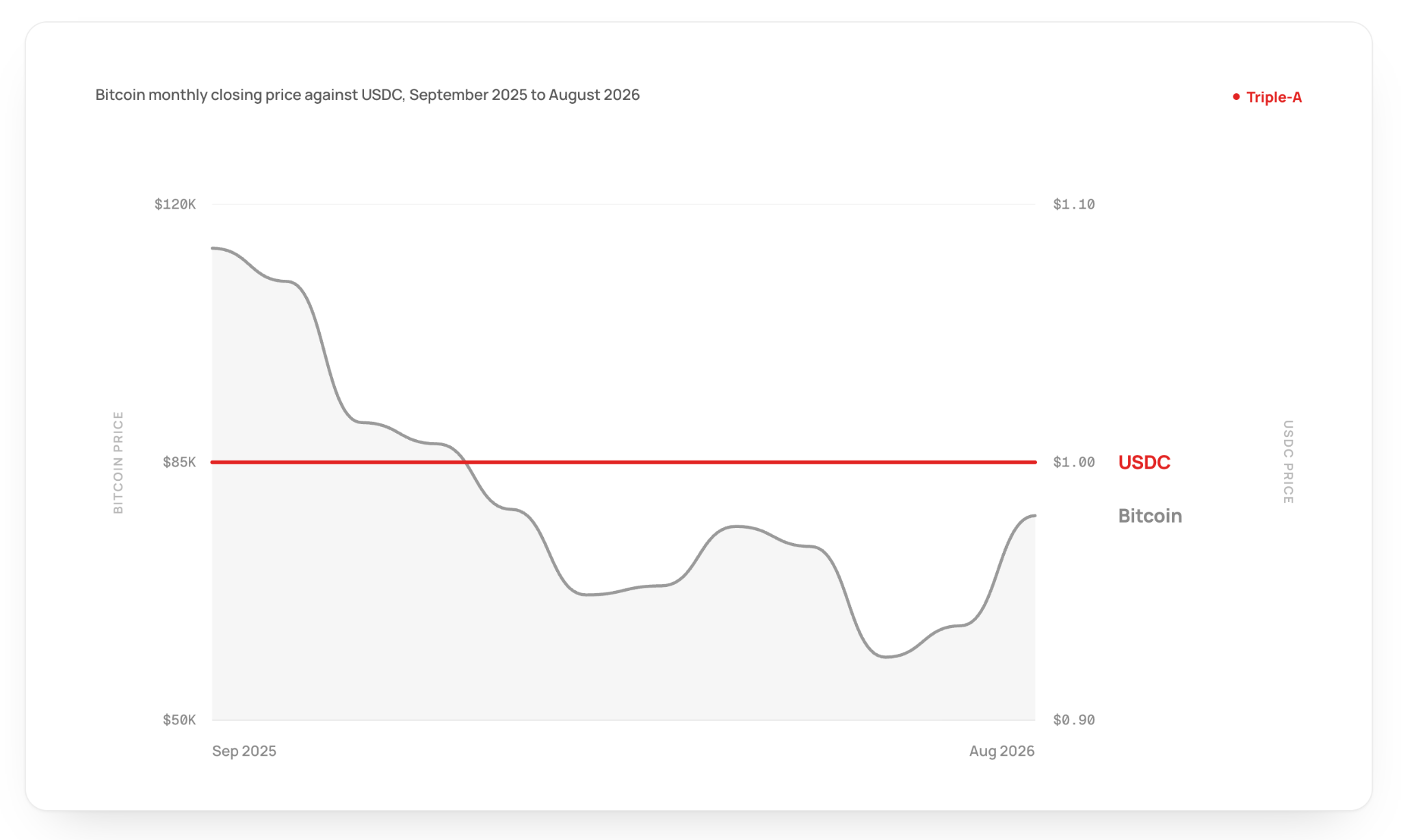
Bitcoin: Bitcoin’s price is set entirely by the market, which gains and loses confidence in it constantly. Its value can change dramatically, rising or falling with legislation, market sentiment, and the broader mood around crypto. For an investor willing to hold onto it, the change in value is an opportunity. But for a business that needs a payment to settle at a fixed amount, it introduces significant risk.
Stablecoin: Stablecoins are usually fiat-backed, which means they are pegged to traditional currencies and backed by reserves like cash and short-term government securities. This keeps their value steady, so a business can treat a stablecoin like a digital version of the money it already uses.
Who Governs Them
Bitcoin: Bitcoin runs on a decentralized network with no central issuer or authority behind it. Its transactions are validated by a global network of participants, which makes it secure and resistant to censorship. But it also means no single company or government stands behind it.
Stablecoin: Stablecoins, on the other hand, are issued and managed by organizations that hold the reserves behind each token, such as USDC and USDT. These issuers are increasingly regulated, under frameworks such as the GENIUS Act in the US and MiCA in the EU, which gives businesses a clear, accountable party to rely on.
How They Perform as Payments
Bitcoin: Bitcoin settles on a single blockchain, meaning it can slow down or become expensive when the network is busy. Layers built on top of it, such as the Lightning Network, can make small payments fast and cheap. However, these layers are mostly used by crypto-native businesses.
Stablecoin: Stablecoins, on the other hand, were built to move. They are available across multiple blockchains, and settle in minutes regardless of which you use. Stablecoin payments can be made at low cost around the clock, even across borders. They alleviate the need to rely on banking hours, costs, and holiday schedules to move money quickly.
How They’re Taxed
A note about taxing crypto: In the U.S., the IRS classifies digital assets as property for federal tax purposes. This means spending crypto is treated as selling an asset at fair market value, and so you must recognize a capital gain or loss on the difference from your cost basis. The size of the transaction doesn’t matter, and no de minimis exemption currently exists.
Bitcoin: For Bitcoin, every vendor payment, every payroll run, and every settlement becomes a separate disposal event, with a gain or loss your team has to calculate and report. If Bitcoin has appreciated since you acquired it, paying a supplier would trigger a taxable gain.
Stablecoin: For a dollar-pegged stablecoin, the same rules technically apply, but it’s not as complicated. Because the coin holds a steady value, the gain or loss on each disposal is usually negligible. While you may still be obligated to report it, the tax liability and the reconciliation burden largely disappear.
Overall, while both Bitcoin and stablecoins can be useful for businesses that want to move money, they differ significantly.
Here’s a summary of how they compare across the features that matter most to a business.
In summary, while Bitcoin is optimized to hold and grow value over the long term, stablecoins are optimized to move value predictably in the present. Both can be useful: it just depends on the job you need it to do.
Why Businesses Choose Stablecoins
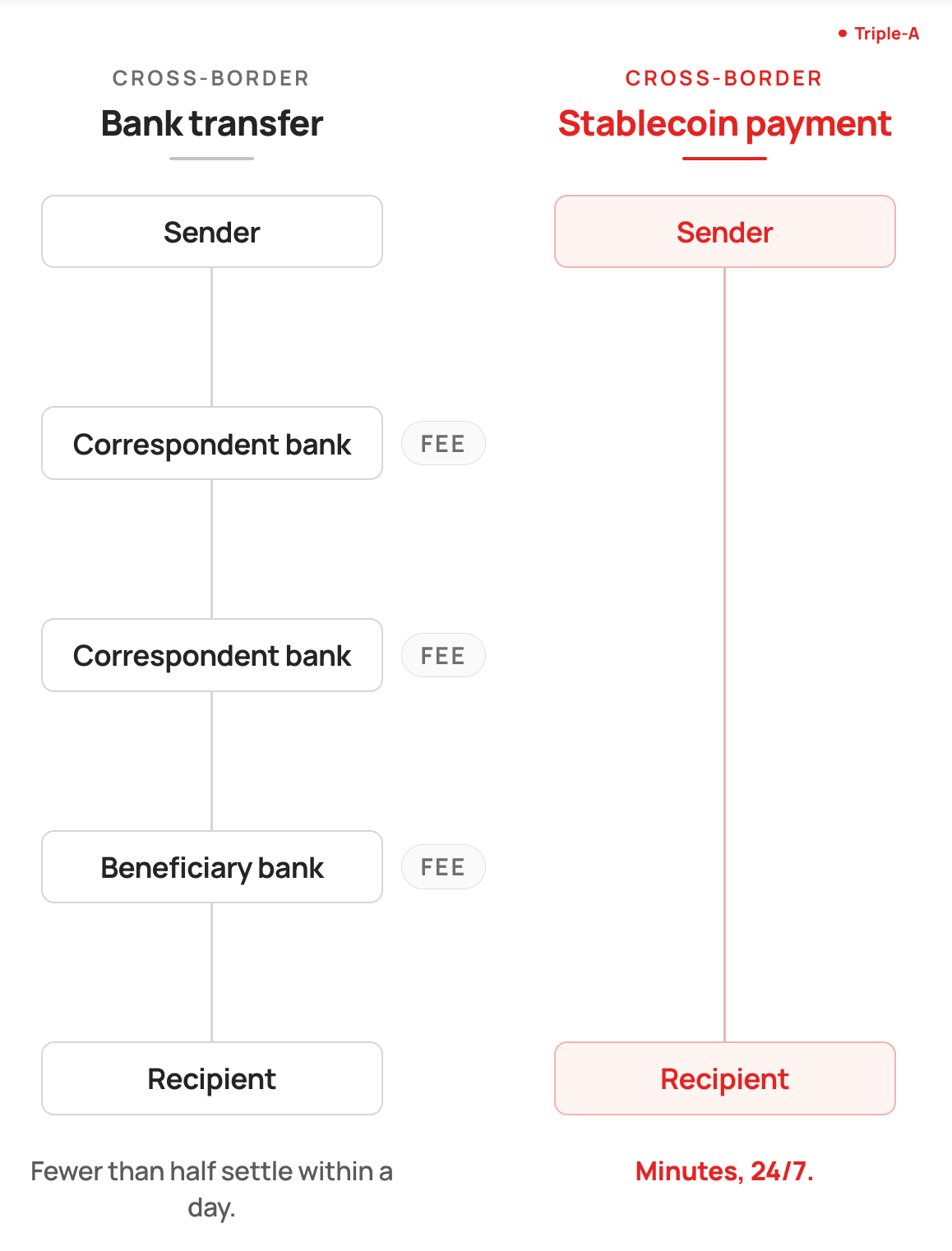
Cross-border business payments are typically much more expensive than domestic money transfers. They also take a lot longer to settle. Those gaps lead many businesses to look into using blockchain rails for their international money transfers.
Here are some of the benefits of using stablecoins:
Invoiced and received amounts match
When you owe a supplier $40,000 and settle in a dollar-pegged token, the supplier receives $40,000. This stability alleviates the need for building hedging instruments or FX buffers into the quote. It also prevents margin erosion between the purchase order and the payment run.
Money transfers arrive in minutes
Blockchain networks run 24/7, even on weekends and bank holidays. That means if you make a payment on Friday evening, it will arrive on Friday evening. For businesses paying contractors across time zones, or holding a shipment until payment clears, this speed can remove a lot of scheduling friction.
Reconciliation gets easier
Every payment carries an on-chain record that includes a timestamp, an amount, and a destination. This gives finance teams a verifiable audit trail and gives both parties a ledger that keeps reconciliation clear.
The cost is clear in advance
Sending money across borders with stablecoins costs a fraction of a percent in network fees. What’s more, you know what the fee is before you send the payment. Wiring money, on the other hand, involves intermediary deductions that may only become apparent when the recipient tells you how much actually arrived.
Cash cycles shorten
Money that moves faster means less money sitting idle in transit and more money that can be used in the moment. For businesses, shortening settlement windows across hundreds of payments a month makes a significant difference to their working capital.
Bitcoin vs Stablecoin: The Final Word
While both Bitcoin and stablecoins are cryptocurrencies, they actually function in very different ways. Because Bitcoin is not tied to any fiat currency, its value is based on how the market sees it, with no floor and no ceiling. Just in the last year it’s swung from over $114,000 to under $59,000. So if the value dips significantly between when you're paid and when you convert or spend it, you bear that loss.
Stablecoins, on the other hand, don’t carry that risk because they are increasingly regulated and backed by fiat currencies. This means that a dollar-pegged token from a reputable, reserve-backed issuer will still be worth a dollar, regardless of when you convert it or spend it. This makes it the best suited cryptocurrency for transferring money across borders.
That’s why most businesses that work with digital assets actually use both Bitcoin and stablecoins, but for different jobs. They use Bitcoin as a reserve holding but stablecoins for payments.
If your business is looking for a way to move money across borders faster and cheaper, stablecoins may be the right cryptocurrency for you.
To see how stablecoin payments can fit your business, talk to the Triple-A team.
FAQs
Is Bitcoin a stablecoin?
No. Bitcoin’s price is determined by supply and demand on the open market, so its value can fluctuate significantly. A stablecoin is designed to hold a steady value, typically by being pegged 1:1 to a fiat currency such as the US dollar.
What is the difference between a stablecoin and a cryptocurrency?
A stablecoin is a type of cryptocurrency. What sets stablecoins apart from other cryptocurrencies is that they are designed to maintain a steady value by pegging to a stable asset, such as a fiat currency. This makes stablecoins well-suited for payments.
Which is better for business payments, Bitcoin or stablecoins?
For payments and settlements, fiat-backed stablecoins are generally preferable to Bitcoin. In addition to offering predictable value, stablecoin payments can settle faster and typically avoid the capital gains calculation that a Bitcoin payment can trigger with every transaction.
Can a stablecoin be frozen?
Yes. Major stablecoin issuers can blacklist an address, preventing tokens held at that address from being sent or redeemed. Such actions may follow a law enforcement request or court order. Bitcoin has no issuer and therefore cannot be frozen in the same way.
Do I owe tax when I pay a supplier in crypto?
In the US, generally yes. The IRS treats digital assets as property, so paying with crypto is treated as a disposal that can trigger a capital gain or loss. With a dollar-pegged stablecoin, that amount is usually negligible, but the transaction may still need to be reported. Confirm the specifics with your accountant or tax adviser.