How to Accept Crypto Payments as a Business (2026 Guide)
[Last updated: 31 July 2026]
Accepting crypto payments means letting customers pay you in digital currencies such as stablecoins or Bitcoin. Instead of a card network, the payment settles on a blockchain, where you can accept it in your wallet or receive it as regular currency into your bank account.
To accept crypto payments as a business, you need to know the rules for the markets you operate in, which cryptocurrencies have real demand among your customers, and how you'll accept them. Many businesses do this through a licensed crypto payment gateway, such as Triple-A, which collects the crypto and settles the payment in local currency
The timing couldn’t be better: 4 in 10 US merchants already accept digital assets, and since 2025 there has been significant regulatory movement in the US and EU.
In this guide, we cover each step in detail, explain what happens during a payment, and what businesses that made the move report.
How do you accept crypto payments?
There are three main ways to accept crypto as a business. They differ mainly in how much of the process you run yourself:
- Crypto payment gateway: A licensed provider does the work for you: it collects the payment, handles the blockchain side, converts the crypto, and pays you in your own currency. This is the simplest route and the one many businesses choose.
- Direct to your own digital wallet: Customers send crypto straight to a digital wallet you control. You don’t have to pay a provider fee, but it means that security, price swings, tax tracking, and compliance are all yours to manage.
- Your own infrastructure: You build the full setup in-house — wallets, conversion, and compliance. It gives you the most control but it only makes sense at high volume.
How to implement crypto payments in 5 steps
These five steps take you from deciding if crypto is suitable for your business to accepting your first payment: assess the demand, clarify the rules, choose your coins, select your provider, and finally, integrate and launch.
Step 1: Decide whether crypto fits your business
First things first, you need to figure out if adding crypto is a good option for your business. Will enough customers use it when paying for your products or services?
Three checks answer that: where your customers are based, who they are, and how much your current payment methods cost. Here are the green flags you should be looking for:
- Your customers are in high-adoption markets: Crypto ownership is far higher in some countries than in others. Country-level ownership data shows that markets like the UAE, India, Singapore, Turkey, Argentina, and Brazil have rates several times higher than the global average. The demand already exists for selling or growing in those markets
- Your customers are crypto-friendly: Some audiences are more likely to pay in crypto: shoppers in high-inflation or emerging markets, gamers and other digitally native buyers, and freelancers or businesses that get paid across borders. Crypto users also typically skew younger: 67% of US crypto owners are under 45.
- Crypto solves an existing payment problem: If you are dealing with cross-border card declines, chargeback losses, or a high-risk label from card networks, crypto could be a wise option. It settles across borders, can't be charged back, and doesn't depend on card networks.
When you are clear on the relevant regulations, settle the following with your finance team:
- How sales are recorded: In many countries, crypto is treated as property, so each sale is booked at its fiat value at the moment of payment. If you convert straight to fiat, that value is your revenue and nothing else happens. If you hold the crypto, any change in its value before you convert becomes a taxable gain or loss.
- How refunds work: Since crypto payments generally can't be reversed, you need to issue refunds yourself, based on the original sale's fiat value.
Step 3: Choose which cryptocurrencies to accept
Now, prioritize the cryptocurrencies your customers will actually use. For most businesses, that means Bitcoin, Ether, and stablecoins like USDC and USDT.
Stablecoins are a strong starting point. Because their value is pegged to a currency such as the US dollar, payments settle at the same price as at checkout. This removes a major barrier that makes merchants wary of crypto: volatility. That is leading to growing confidence in — and adoption of stablecoins, which have grown from less than USD 10 billion to more than USD 300 billion in just 6 years.
Here’s a quick comparison of key cryptocurrencies:
Explore the top stablecoins, and which are best for your payments.
Step 4: Choose your acceptance model and provider
Once you’ve settled on your cryptocurrencies, choose how you want to get paid. Then, find a provider that can handle payments in that way.
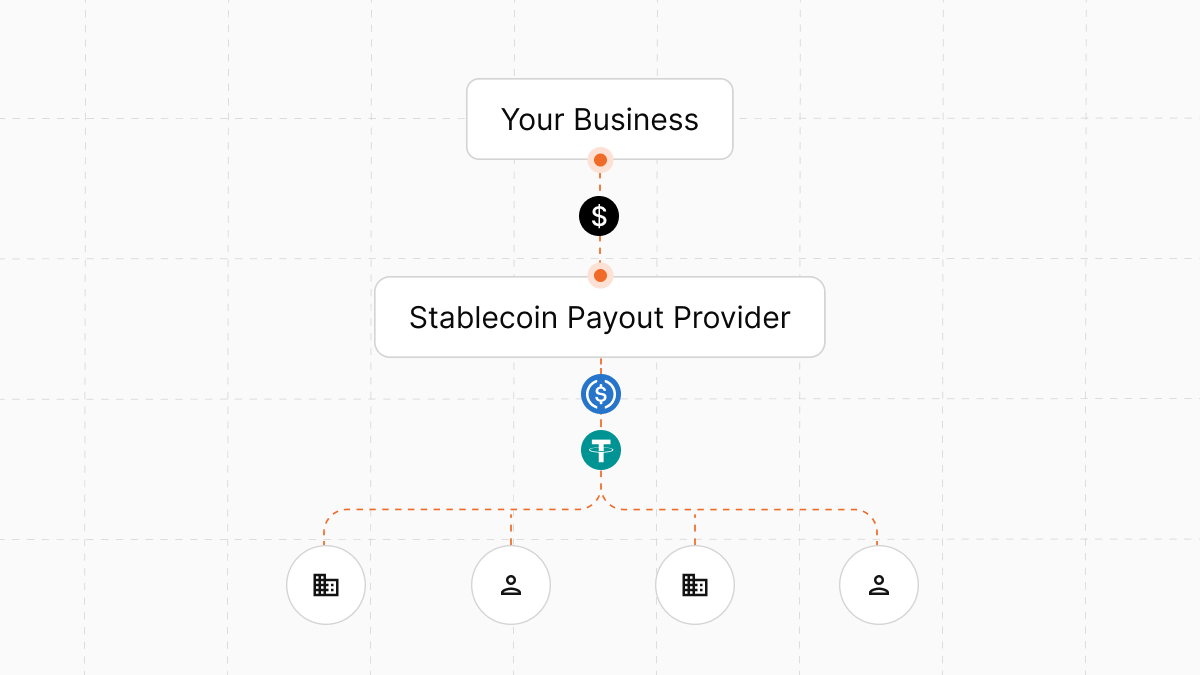
As covered above, many businesses want crypto automatically converted into their own currency. This is where a payment gateway comes in: it takes the crypto, converts it, and pays you in fiat.
If you would rather keep the crypto, you can either collect it in your own wallet or set up your own payment infrastructure.
Here’s a quick comparison of the options:
If you decide to go with a payment gateway, you need to ensure it can handle your day-to-day crypto payment needs. Here’s a checklist for assessing crypto payment gateways:
Step 5: Integrate, test, and launch
Finally, you need to add your payment option, decide how the money will reach you, and run a few test payments before you go live. Here’s how to run the final set-up.
1. Add crypto to your payment gateways: How you do this depends on how you sell:
- Online commerce: Add crypto to your checkout via a plugin, or through an API and a hosted payment form
- Invoiced or B2B sales: Send a payment link or invoice — no integration needed
- In person: Let customers pay in crypto by scanning a QR code
With Triple-A, for example, you can integrate stablecoins into your checkout via an iFrame or hosted page, or collect payments through the invoicing tool.
2. Choose how you get paid: You have two options here:
- Convert each payment to your currency in your bank account. Like an ordinary sale, this keeps your books in local currency and your revenue steady.
- Collect payment in the digital currency, if you intend to hold crypto as an asset to revalue over time.
Choose the best option once during setup, and the gateway will apply it to every payment.
3. Test, then launch: Send a few small real payments to confirm they show up correctly in your provider's dashboard. This is where every transaction appears with its amount and status. Once everything is set correctly, be sure to advertise the crypto payment option in your marketing assets. From the same dashboard, you can monitor how many customers take the option to pay in crypto.
What happens when a customer pays in crypto
A crypto payment takes a few minutes at most, and neither you nor the customer needs to understand blockchains. Even so, it’s wise to have a general idea of how crypto payments work. Here’s an example:
A customer in Buenos Aires picks your product and chooses crypto at checkout. From there,
- They pick a coin from your accepted list (e.g., USDC) and the chain (e.g., Ethereum)
- The provider shows the exact amount at a fixed exchange rate, and gives them a one-time QR code for their order
- They approve the payment from their wallet app or exchange account
- The network confirms the payment. Stablecoins usually confirm within minutes; Bitcoin can take longer.
- You and the customer both get a confirmation, and the order flips to “Paid”
- The provider converts the USDC and sends the payment to your bank account in your preferred currency. Alternatively, if you’ve chosen to hold crypto, it goes to your wallet instead.
Note: Unlike card payments, a confirmed crypto payment cannot be pulled back: there are no chargebacks. Refunds are possible, but you must issue them yourself, based on the fiat value of the original sale.

Benefits and risks of accepting crypto
The case for accepting crypto payments is that it opens your business up to new customers, with faster settlement and no chargebacks. The case against lies mostly in volatility and accounting complexity, though these apply only if you hold the crypto yourself.
Here’s a breakdown of the risks to consider and how to address them:
Businesses are increasingly seeing that the benefits outweigh the risks. Crypto now accounts for 26% of sales on average for US merchants that accept it, with 72% of those seeing sales grow over the past year. Businesses that use Triple-A as their payment provider are also seeing the results:
- Farfetch, the luxury marketplace, is averaging 56% more orders in digital currency than others, with 75% of stablecoin payers returning.
- G2G and OffGamers, gaming marketplaces in over 100 countries, have seen stablecoin volume grow by 190% in a year and have cut seller payouts from days to seconds.
- Grab, the Southeast Asian superapp, saw a rapid adoption of the stablecoin wallet top-up feature, with processed volume growing 43% month-on-month for the first 6 months.
Start accepting crypto payments with Triple-A
Crypto payments let you reach more customers and settle transactions faster, without adding unnecessary operational complexity.
A licensed payment gateway can run the process — handling the payment flow, converting each payment to fiat, and depositing the funds into your bank account — so your business can reap the benefits without the risk.
Talk to the Triple-A team to see how to start accepting crypto in 2026.
FAQs
What does it mean to accept crypto payments?
Accepting crypto payments means allowing customers to pay in digital currencies such as Bitcoin, Ether, or stablecoins. The payment settles on a blockchain instead of on a card network. You can receive the money in crypto or, through a gateway, in your own currency.
How do crypto payments work?
At checkout, your customer selects crypto and chooses a coin and network.Your provider displays the amount at a fixed exchange rate and offers customers a payment method: a wallet button, an online payment link, or a QR code. The customer approves the payment from their wallet or exchange account, the network confirms it in minutes or seconds, and your provider marks the order as paid and settles the payment according to the preferences you have selected.
Is it legal to accept crypto payments?
Yes, in many major markets, including the US, the EU, the UK, and Singapore, it is legal to accept crypto payments. These jurisdictions have legislation in place, such as MiCA in the EU and the GENIUS Act in the US, to regulate crypto payments. A few countries like mainland China and Turkey restrict the use of cryptocurrencies directly or indirectly to pay for goods and services, so be sure to check every market you sell into before launching.
Do I need a license to accept crypto?
In most markets, you don’t need your own license just to accept crypto as payment for goods or services. However, licensing typically applies to activities such as holding customer funds, exchanging crypto for fiat, or operating a payment service. If you have a payment provider that handles those functions, you should ensure that provider holds the required licenses in the jurisdictions where you sell and settle.
How are crypto payments taxed?
In many countries, crypto is treated as property, not currency. You record each sale at its value in your currency at the time of payment. That figure is your revenue. If you hold the crypto and its value changes before you convert it, the difference is a taxable gain or loss. Using a payment gateway that converts to fiat on every sale keeps this simple, since there is nothing left to revalue. Confirm the specifics with a tax professional in your jurisdiction.
How do crypto payments affect accounting and reconciliation?
It depends on whether you hold crypto. If your provider converts every payment to fiat, each sale reconciles like a card or bank payment, and you book the fiat amount you received. If you hold crypto, however, it becomes an asset on your balance sheet that you revalue over time. Whichever approach you take, use a provider who reports the cryptocurrency, its fiat value at the time of payment, and the settlement date for each transaction.
Do I have to hold crypto on my balance sheet?
No, you don’t have to hold crypto. If your payment provider converts payments to fiat before settlement, no crypto shows up on your balance sheet. For example, Triple-A converts each payment and settles it to your bank account the next business day, so no crypto ever touches your books.
Which cryptocurrencies should I start with?
Bitcoin, Ether, and the two leading stablecoins, USDC and USDT. Together they account for most customer payments. Thousands of other coins exist, which you can add later if your customers ask.
Can customers get refunds on crypto payments?
Yes, customers can get refunds on crypto payments, but the mechanics differ from cards. A crypto payment cannot be reversed, so instead of a customer opening a dispute, you process the refund yourself from your provider's dashboard. Refunds are typically issued based on the fiat value of the original sale, so neither side gains nor loses from price movements after the purchase.
Do I have to run KYC or anti-money-laundering checks before accepting crypto payments?
Generally no, if you use a licensed gateway. Screening customers and monitoring for suspicious activity is part of the provider's job, and it is one reason to choose a licensed one. However, if you accept crypto directly into your own wallet, that responsibility falls to you. It’s generally wise to get familiar with the main regulations in your jurisdictions and how they might affect your business.